Order raw beef and live octopus in Korea and you’ll get one of two reactions from foreigners at the table: excitement, or quiet panic. I had this dish at a restaurant near Gunja Station in Seoul on a hot June evening, and the thing that struck me wasn’t the moving tentacles — it was how ordinary it felt to everyone else in the room.
Because here’s what almost every English-language article gets wrong about this dish: it is not a dare. It’s a stamina food. And it has been treated that way in Korea for over two hundred years.
What you’re actually looking at
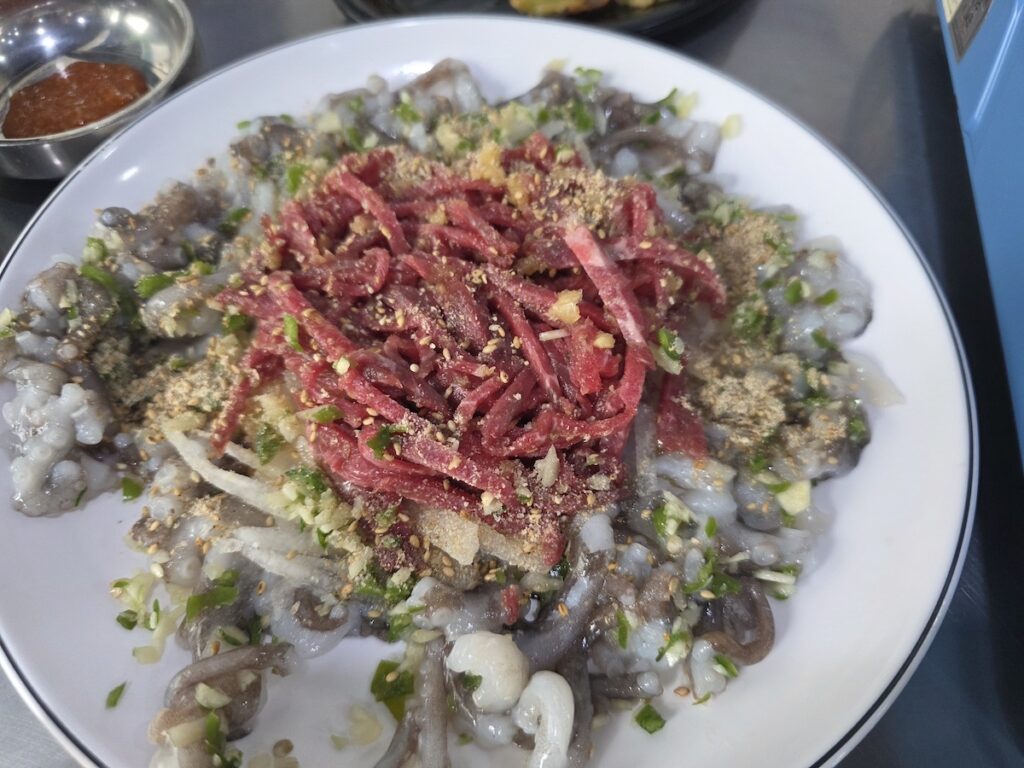
The dish is yukhoe nakji tangtangi (육회낙지탕탕이). Two components on one plate:
- Yukhoe (육회) — Korean raw beef, cut into thin strips, seasoned with sesame oil, sesame seeds, garlic, and often pear. Think steak tartare, but julienned rather than minced.
- Nakji tangtangi (낙지탕탕이) — small octopus, chopped fresh. The name comes from tangtang, the sound of the knife hitting the board.
“Tangtangi” is originally a regional dish from the southwestern coast — Mokpo, Muan, Yeongam in South Jeolla Province — where the octopus comes from tidal flats and freshness is the whole point.
The two things are eaten together, wrapped in seaweed or dipped in sesame oil and salt. The contrast is the appeal: beef that’s soft and nutty, octopus that’s springy and briny, sesame powder tying them together.
The part nobody explains: it’s medicine, not a stunt
There’s a Korean saying that octopus will get a collapsed ox back on its feet.
That isn’t a joke. It comes from the Jasan Eobo (자산어보), Korea’s first fish encyclopedia, written in 1814 by the scholar Jeong Yak-jeon during his exile on Heuksando. He recorded that feeding three or four octopus to a starved, weakened ox would restore its strength almost immediately.
Modern nutrition doesn’t entirely disagree with the sentiment. Octopus is unusually high in taurine — around 871mg per 100g, compared with roughly 396mg in oysters and 200mg in seaweed — along with protein and minerals, with very little fat.
I’m not going to tell you it’s a miracle cure. But I will tell you this explains what you’re seeing in the restaurant. When two Korean men in their thirties or forties sit down and order the beef-and-octopus plate with a bottle of soju on a humid summer night, they are not being adventurous. They’re doing something closer to what someone elsewhere might do with a steak and a protein shake. It’s a “let’s take care of the body” meal. Sometimes you stop looking at the price and think about your body instead — that impulse is exactly what this dish is for.
There’s even a seasonal proverb: spring clams, autumn octopus (봄 조개 가을 낙지). Autumn is when octopus is considered at its peak, having fattened up before winter.
What it costs
Real numbers from my meal near Gunja Station, Seoul:
| Item | Price (KRW) |
|---|---|
| Yukhoe + live octopus combo | 45,000 |
| Live octopus alone | 30,000 |
The 45,000 plate comfortably fed two adult men as drinking food. That’s the standard use case — this is anju (안주), food ordered to go with alcohol, not a solo lunch.
Prices in the famous tourist markets tend to run similar or higher. The combination generally sits in the 25,000–45,000 range depending on the neighborhood and how much beef you’re getting.
How to eat it safely — read this part
The octopus pieces move. This is normal, it’s the freshness signal, and it is also the part you need to take seriously.
The single most important thing: chew thoroughly before swallowing. Every piece. The suckers can still grip, and the risk with this dish is choking, not poison.
A few practical points:
- Dip it in sesame oil. This isn’t only for flavor — the oil coats the suckers and makes them far less grippy. This is why it’s always served with 참기름 소금장 (sesame oil with salt).
- Take small amounts. Don’t load your chopsticks.
- Don’t rush, don’t do it on a dare, and don’t do it very drunk. The combination of “swallow fast” and “impaired” is the actual danger.
- Not for young children or anyone with swallowing difficulty.
About that Oldboy scene
If you know this dish, you probably know it from Oldboy (2003), where Choi Min-sik bites into a whole live octopus. That scene made sannakji globally famous — and globally misunderstood.
No Korean eats it that way. What’s served in restaurants is chopped into small pieces first. Attempting the film version would be genuinely dangerous. What you’re being served is a prepared dish, not a challenge.
Where to try it: skip the obvious answer
Most English guides send you to Gwangjang Market or Noryangjin. Both are fine and both are crowded with tourists paying tourist attention.
My recommendation is Garak Market (가락시장).
Garak is known internationally as a seafood market, but that’s only half of it — the butchery section is enormous, and that matters for this dish specifically, because you need both good beef and live octopus in the same building.
The system works like this:
- Buy your ingredients on the first floor — pick your octopus, pick your beef, straight from the vendors.
- Take them upstairs to a restaurant on the second floor.
- Pay a table charge (상차림비, sangcharimbi) and they’ll prepare, plate, and serve it with side dishes.
You’re paying market price for the ingredients plus a preparation fee, rather than restaurant markup on both. And you choose exactly what goes on your plate.
Getting there: Garak Market Station (가락시장역), Seoul Subway Lines 3 and 8.
If you’d rather just sit down and order, ordinary neighborhood restaurants — like the one I went to near Gunja Station — serve this all over Seoul. It is not an exotic item. It’s on a lot of menus.
How to order it
Point at the menu and say:
- 육회낙지탕탕이 — yukhoe nakji tangtangi — the combination
- 산낙지 — sannakji — live octopus alone
- 육회 — yukhoe — raw beef alone
If you want the beef but not the moving part, ordering yukhoe by itself is completely normal and nobody will think anything of it.
Is it worth it?
If your only interest is the shock value, you’ll be disappointed — chopped octopus in sesame oil is a texture experience, not a horror film.
But if you want to understand something real about how Koreans eat, this is a good dish to understand. It sits at an intersection that doesn’t exist in most food cultures: a dish that is simultaneously a delicacy, a drinking snack, and something close to a tonic. That framing — food as fuel for the body, ordered deliberately in the heat of summer — tells you more about Korean eating than a hundred photos of moving tentacles.
I ate this dish near Gunja Station in Seoul in June 2026; the prices above are what I actually paid. Prices vary by neighborhood and season — treat them as a reference point, not a quote.
Have you tried yukhoe nakji tangtangi somewhere worth recommending? Tell me and I’ll add it here.