Korean beef intestines gopchang was not something I planned to eat that Saturday.
A junior colleague from my office had asked to meet on a public holiday. In Korea, that is a specific kind of ask. Meeting a coworker on a day off requires a small but real amount of courage — from the person asking, at least — because it crosses a line the week normally keeps clean. Weekdays for work, weekends for anyone else.
He had asked anyway. I said yes anyway. That is how we ended up in a small restaurant in an alley I would not have walked into on my own, sitting in front of a round metal pan slowly filling with pale, curled pieces of intestine.
This is that afternoon.
Quick Answer: Korean beef intestines gopchang is grilled offal from beef, usually served at specialty restaurants that also offer daechang (large intestine) and makchang (fourth stomach). Gopchang refers to the small intestine — chewy, rich, with a soft interior fat called gop. Daechang is fattier and puffs up on the grill. Makchang has a firmer, meatier texture. Pork versions exist and are cheaper, but come with a stronger smell. Expect to pay 25,000 to 40,000 KRW per person at a decent beef gopchang restaurant, more if you order modeum (mixed platter). Order modeum if it is your first time. Wrap the pieces in perilla leaves. Drink soju. Ask your senior — or your junior — to explain the parts you cannot pronounce.
The invitation that a holiday cannot refuse
In Korean offices, seniority runs through everything, including social invitations. There is a soft rule that a seonbae (senior) and a hoobae (junior) do not become friends automatically just because they sit near each other. Friendship, if it forms at all, is negotiated slowly. Often it takes the form of a spoken agreement — let’s have dinner twice a year — which sounds cold to non-Korean readers but is, in this culture, an intimate promise. Two dinners a year is more contact than most seonbae-hoobae pairs will ever have.
My junior and I had made exactly that agreement. Two dinners a year, on the calendar somewhere. He had chosen this holiday to cash one in.
Saying no would have been technically allowed. I had every excuse — heat, laundry, a nap I was owed. But there is a specific weight when a normally quiet junior asks for time on a day off. It means the request has been considered. It has passed through his own internal filter of is this appropriate, will this be received well. By the time it reaches you, refusing is not just declining a meal. It is declining a small act of trust that took him a week to work up to.
So I said yes. And then, because I am a Korean senior in a Korean setting, I did the next thing my role required. I asked him what he wanted to eat.
Why the senior pays, and why “delicious” means “expensive”
In Korean workplace dining, the senior pays. This is not codified anywhere, but it is universal in practice. The senior earns more, has been in the industry longer, and is understood to be in a phase of life where treating a junior is part of the job of being older. If a junior tries to pay, the senior refuses with a version of put it away, this is my treat. A junior who insists is polite. A junior who insists twice is memorable.
There is a second, quieter rule that shapes the whole meal. When a senior asks what do you want to eat, the answer a junior gives is almost never their true first choice. It is a filtered choice — filtered through the price they think the senior can afford, the reputation of the neighborhood they are in, and the unwritten limit on how much they should feel comfortable spending of someone else’s money.
The compound effect of these two rules is that when a Korean asks let’s eat something delicious, the phrase almost always means let’s eat something expensive. Not because Koreans equate quality with price, but because within the seonbae-hoobae dynamic, choosing something inexpensive can read as underestimating the senior’s willingness to spend. Choosing something expensive reads as trust — my senior will take care of this.
I have been in Korean offices long enough that I heard this whole calculation happen in the pause after my question. I saw him think. I saw him land on his answer.
Let’s eat gopchang.
The junior chose gopchang, and I did not fight it
I want to be direct about this. I do not love gopchang.
I do not hate it either. I am somewhere in the middle — a person who understands why other people love it, respects the tradition around it, and would not, on my own, walk into a gopchang restaurant on a public holiday. Left to my own devices I would have picked cold noodles, or a light seafood soup, or one of the summer dishes designed for exactly this kind of humid Seoul afternoon.
But he had picked. And in the seonbae-hoobae arithmetic, once a junior has said what they want, arguing for something else is a small failure of hosting. You do not overrule the answer to a question you asked.
So we went.
The alley he took me to was narrow and unremarkable. The restaurant had no English signage, no photos in the window, and only one small sign in Korean identifying itself as a so-gopchang jeonmun — beef intestine specialist. This was, in its own way, a good sign. Places that print pictures of gopchang on the window are usually the ones you avoid. The good ones do not need to advertise what they are.
We sat down. He ordered before I could suggest anything, which was also correct — a junior who chose the restaurant should take the ordering off the senior’s plate, so the senior does not have to reveal that they do not really know the menu.
Modeum, two portions, he said. Mixed platter. The waiter nodded and walked away without writing it down.
Beef, not pig — a small mercy on a hot day
Before I go further, I need to make one distinction clear, because it is the single most useful thing a foreigner can know before walking into a gopchang restaurant.
Gopchang restaurants are not all the same animal.
The word itself can refer to the small intestines of cattle or the large intestines of pigs, depending on which restaurant you walk into. There are beef gopchang restaurants (so-gopchang, 소곱창) and pork gopchang restaurants (dwaeji-gopchang, 돼지곱창). They are different worlds.
There are beef gopchang restaurants (so-gopchang, 소곱창) and pork gopchang restaurants (dwaeji-gopchang, 돼지곱창). They are different worlds. Beef gopchang is more expensive, milder in smell, richer in flavor, and considered the more refined of the two. Pork gopchang is cheaper, punchier, and carries — fairly or not — a strong reputation for nae (냄새), the specific offal smell that some Koreans love and others cannot get past.
I am on the cannot get past side of pork gopchang, and my junior knew this without me saying so. He had picked a beef place. This was, on a personal level, a small mercy. On a Saturday afternoon in June, with the humidity already in the low eighties, walking into a pork gopchang restaurant would have been a test of my dignity I was not prepared to fail.
Here is the real cost breakdown for someone planning their first visit.
| Item | What it is | Typical price per portion |
|---|---|---|
| So-gopchang (beef small intestine) | The classic — chewy, rich, with gop (internal fat) | 25,000–35,000 KRW |
| So-daechang (beef large intestine) | Fattier, thicker, puffs on the grill | 25,000–35,000 KRW |
| So-makchang (beef fourth stomach) | Firmer, meatier, less fatty | 22,000–30,000 KRW |
| Modeum (mixed platter) | All three, one order | 30,000–45,000 KRW |
| Dwaeji-gopchang (pork intestine) | Cheaper, stronger smell, spicier prep | 12,000–20,000 KRW |
| Dwaeji-makchang (pork rectum) | Chewy, gamey, popular in Daegu | 15,000–25,000 KRW |
Two portions of beef modeum, one bottle of soju, one Terra beer, some perilla leaves, and side dishes — our final bill was around 90,000 KRW for two people. This is the middle range. High-end places in Gangnam will run 120,000 to 150,000 for the same order. Alley places in old neighborhoods can come in under 70,000 for two.
Ordering “modeum” for two: gopchang, daechang, and something I could not name
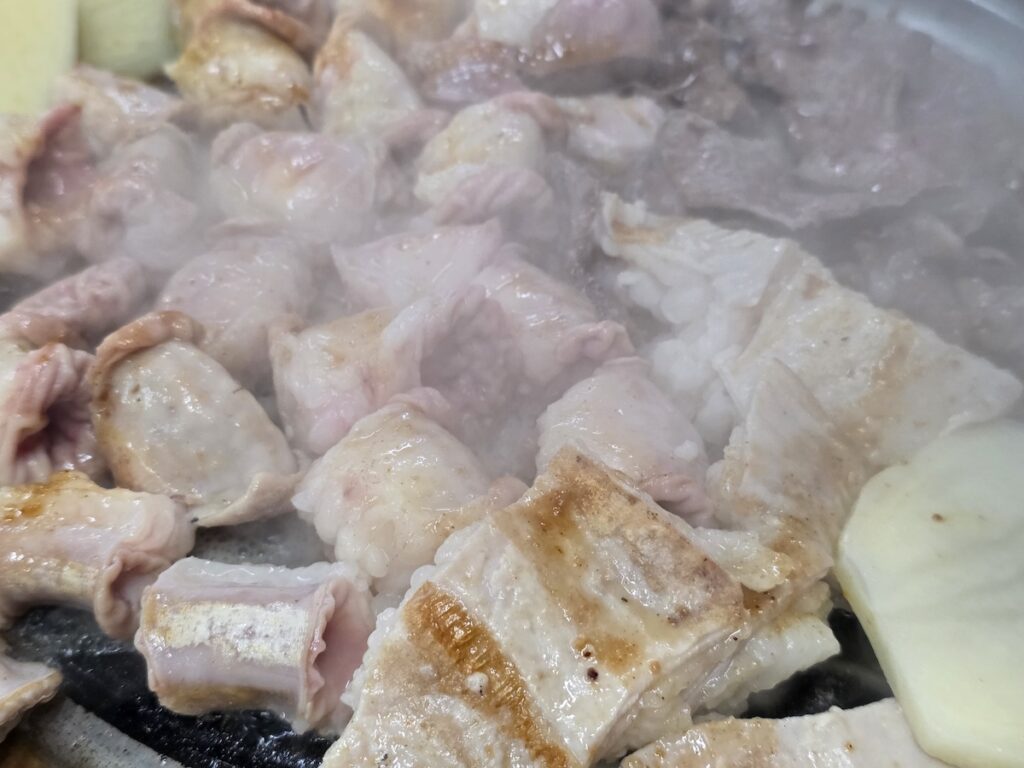
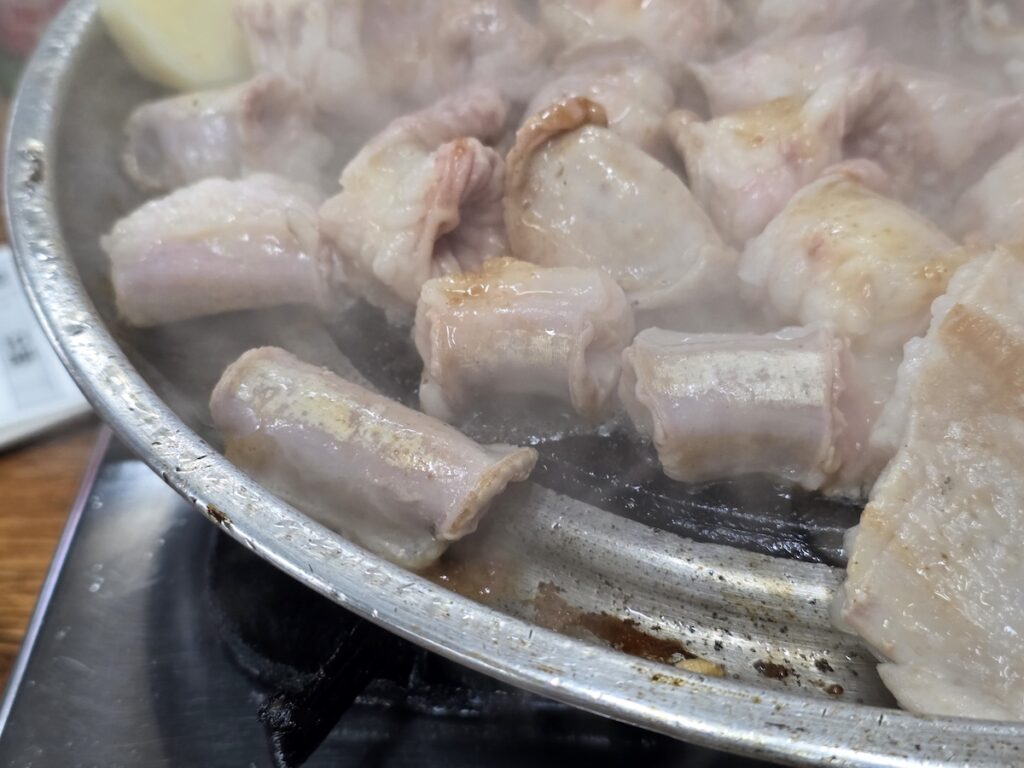
The waiter brought the platter about six minutes later. She dropped it onto the hot round pan at our table, and the pan started to hiss immediately.
Three kinds of pieces were on it. The first two I recognized on sight. Gopchang — the small, tube-like curls with the pale interior fat visible when they curled around themselves. Daechang — the fatter, thicker cross-sections, cut into rounds like small marshmallows, with the fat capped inside like tiny wells.
The third piece I could not confidently name.
It was flatter than the others. Firmer looking. Slightly darker. It did not curl like the intestines did. When I picked one up with chopsticks and pressed it, it had a springy resistance that neither gopchang nor daechang had. It was not soft. It was almost like a scallop with a texture problem.
I sat there for a second with my mouth partly open, thinking, this is a moment where the senior is supposed to look confident. And I was not confident.
My junior noticed and, in the smallest voice possible, said, sunbae, that is makchang. The fourth stomach. Sometimes they mix it into modeum.
I nodded slowly, the way people do when they are pretending they already knew.
The truth is that I did not, until that moment, know exactly which part makchang referred to. I knew it was somewhere in the digestive tract. I knew it was chewy. I did not know it was specifically the fourth stomach of a cow, distinct from the intestines proper, and that its presence in the modeum was a small generosity from the restaurant, since makchang is often ordered separately.
I am telling you this because I have lived in Korea my whole life, I have written about Korean food for years, and I did not know this until a junior in his early thirties told me at a table over cheap soju cups.
This is what a good junior does. Not correct you loudly. Not embarrass you. Just quietly hand you the word you were missing, and then look at the grill so you can take a beat.
Vegetables as insurance, soju as reward
While the pieces cooked, I did what I always do at a gopchang restaurant, which is to look for the vegetables and mentally calculate how many I need to eat per bite of intestine to feel like I am negotiating with my own arteries.
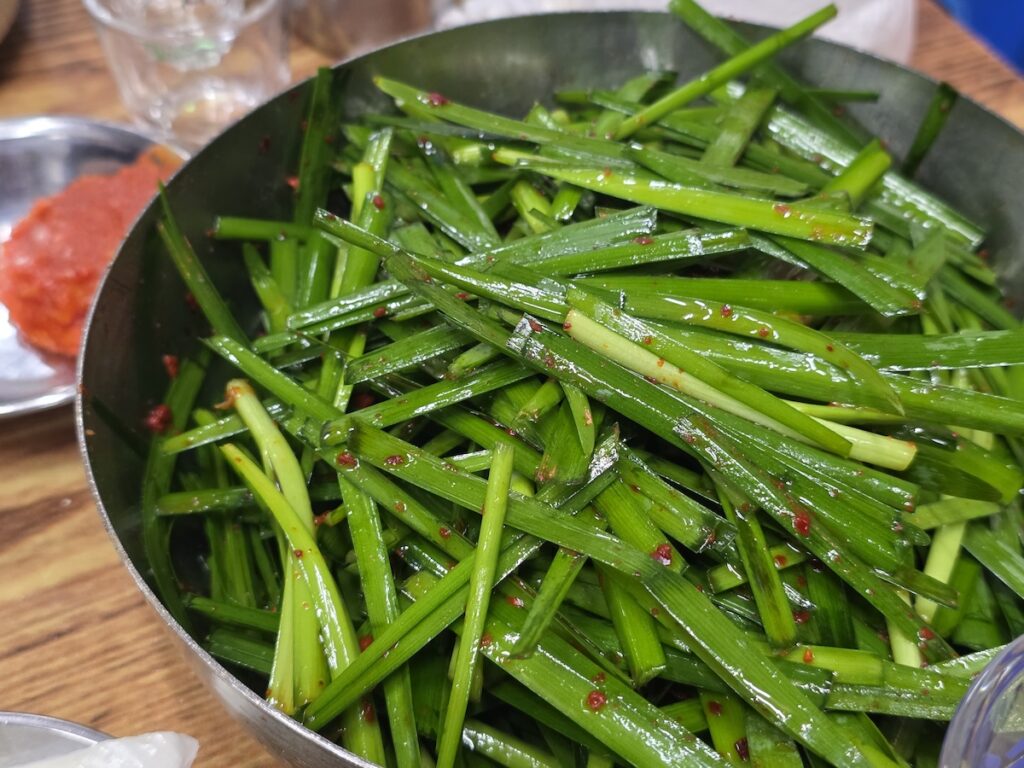
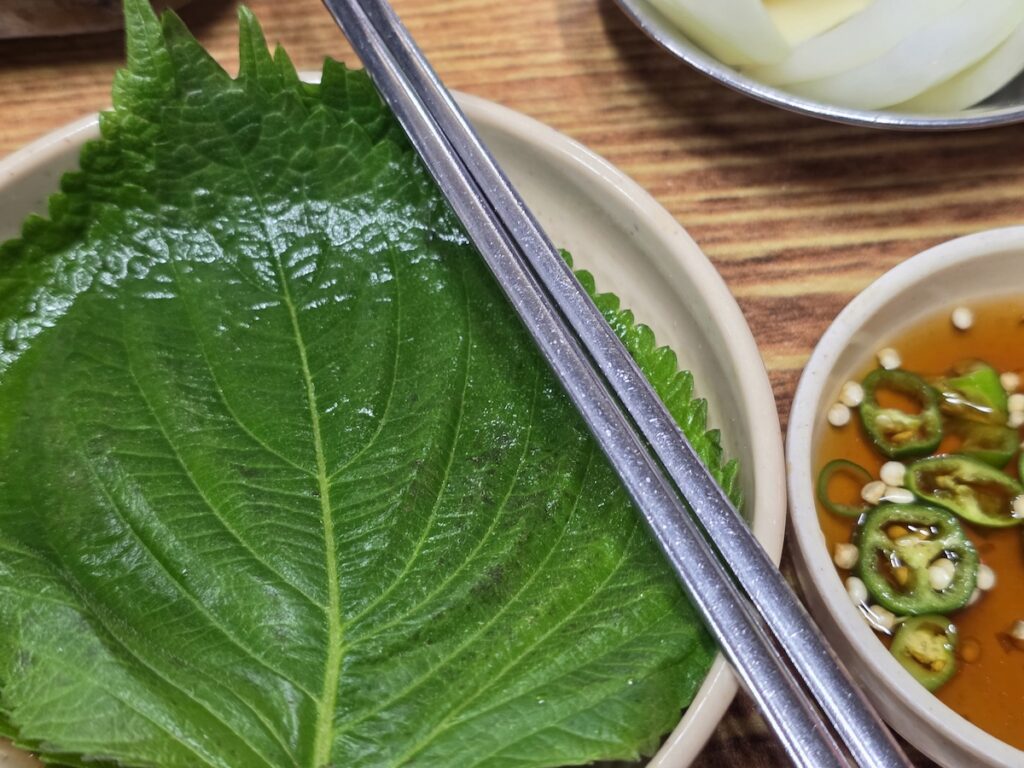
The place had done its job. A large steel bowl of buchu-muchim — Korean garlic chives dressed lightly with chili flakes and vinegar — sat at the corner of the table. Two perilla leaves and a plate of sliced raw onions. A dipping sauce of soy and sliced green chili in sesame oil. A small dish of ssamjang, the fermented soybean paste for wrapping.
I explain this in detail because it matters. Korean grilled offal is not designed to be eaten alone on a fork. The vegetables are not garnish. They are the point. A piece of daechang wrapped in a perilla leaf, with a smear of ssamjang and a strip of buchu on top, is a completely different food from the same daechang eaten by itself. The leaf carries away the fat feeling. The buchu cuts the richness with its own sharp mineral bite. The ssamjang gives it a floor. The whole thing tastes like a plan, not a slab.
This is the version of gopchang that people who love gopchang love. It is not the intestine itself. It is the complete unit — meat, leaf, chives, sauce, soju sip, breath — engineered by the restaurant to be more than the sum of its parts. Even a person like me, who did not want to be here, could sit inside that engineering and feel something reasonable happening.
The soju arrived. He poured for me, I poured for him. We drank the first cup. I ate the first piece.
It was fine. It was more than fine, actually, wrapped in the leaf with the buchu.
I have not converted. I still would not order this on my own. But sitting in that specific chair, on that specific Saturday, with a junior who had spent a week working up the courage to invite me, eating what he had chosen and letting him teach me the word I did not know — the meal was correct in a way that had nothing to do with the taste of the meat.
The one small piece of Korean workplace dining advice I can offer
If you are a foreign visitor invited to eat gopchang by a Korean colleague — junior or senior — here is the summary of everything I have written above, in one paragraph.
Do not overrule the choice. If they picked gopchang, eat gopchang. If they picked pork gopchang and you cannot handle the smell, eat as much as you politely can and drink the soju to compensate. Do not fight over the check unless you are the senior at the table. Wrap the intestine in perilla leaves. Ask what makchang is if you do not know — the question is not embarrassing, and Koreans love explaining their own food. Order the modeum on your first visit; it is the only way to learn which cut you actually like. And if a junior is picking up their part of the tab, let them once, so they know you take them seriously as a person who can also pay.
For a broader look at the etiquette of eating grilled meat in Korea, we have written separately about the unwritten rules of Korean BBQ etiquette in Seoul and the specific dance of Korean BBQ samgyeopsal division of labor. Both apply here, with the small addition that gopchang restaurants are usually noisier and slightly less choreographed than samgyeopsal restaurants — which is part of their charm.
What the dismantling of a cow can teach you
I want to close with the thing I actually thought about, sitting there.
The Korean word for a cow’s parts is not a short list. Between the intestines, stomachs, tongue, liver, heart, lungs, tendons, marrow, and the smaller cuts most non-Korean cuisines throw away, a single cow can be broken into fifty or sixty named parts, each with its own cooking method, its own dedicated restaurants, its own regional variations, and its own seasonal pricing.
Sitting there with pieces of small intestine, large intestine, and fourth stomach on the same grill, I realized what the meal was actually showing me. It was not showing me offal. It was showing me the depth of a food culture that decided, at some point centuries ago, that no part of an animal was going to be wasted, and every part deserved its own name.
The word for that, in retrospect, is respect. Respect for the cow, respect for the labor, respect for the eaters who developed the palate to appreciate what a lazier culture would have thrown into a stockpot. The reason I did not love gopchang, I realized, was that I had not put in the hours it takes to appreciate what respect for the fourth stomach of a cow feels like on the tongue.
My junior had put in those hours. He was thirty-one. He had grown up going to gopchang restaurants with his father. When he ordered the modeum for two, he was not just picking dinner. He was inviting me into a food that his family had trained him to love, and hoping I would meet him there.
I did not fully meet him there. But I met him closer than I would have if I had refused the invitation.
That is the whole story. Korean beef intestines gopchang is not something I write about because I love it. I write about it because a junior colleague loved it enough to spend a public holiday teaching me a word I did not know, and I owe him the article.
If you are ever invited to eat gopchang in Seoul by someone who cares about it — go. Sit down. Ask what the flat piece is. Wrap it in the leaf.
The cow was dismantled with care. The meal is the same.