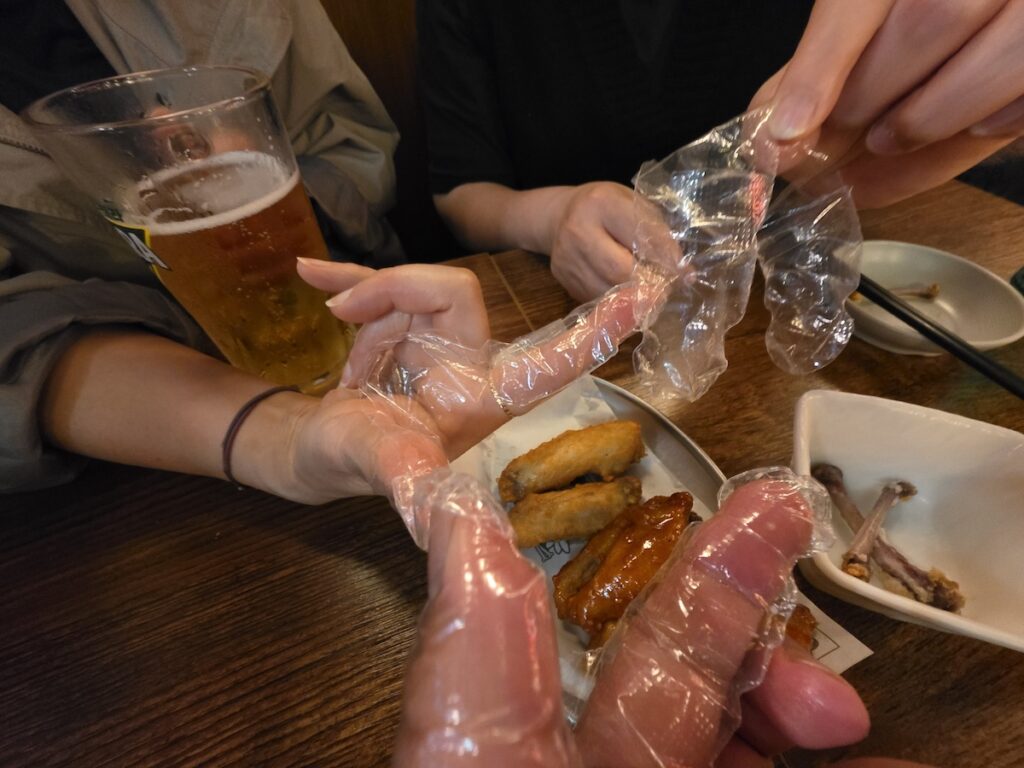
We were three beers into a plate of fried chicken when my friend stopped, held up his hand, and started laughing at it. On his thumb and index finger — and only those two fingers — sat a pair of thin, clear plastic sheaths, twisted tight at the base like tiny balloons. The other three fingers were bare. Around the table, everyone had done the same thing without thinking about it. To us it was invisible. To someone watching, it was one of the strangest, most specific things about how Koreans eat.
If you spend any time at a Korean fried chicken place, you’ll meet these little Korean plastic gloves. And once you notice them, you start seeing them everywhere — and wondering what they say about the whole culture of eating here.
First, what exactly are these?
Two different things get called “plastic gloves” (비닐장갑, binyl-jang-gap) at a Korean table, and the distinction matters:
- The full glove. A normal thin, loose, food-safe plastic glove for the whole hand. These often sit in a little dispenser box on the table, or you ask the staff — “binyl-jang-gap isseoyo?” (“do you have plastic gloves?”). You pull one on when you want to handle food fully — pork trotters, ribs, anything you’re tearing apart.
- The finger version. This is the one in the photo, and it’s the one that surprises people. Small plastic sheaths meant for just the thumb and index finger — the two fingers that actually pinch the chicken. At many chicken places these arrive with the food, counted out one set per person, no asking required.
That detail — that the restaurant portions out finger-gloves by headcount the moment the chicken lands — tells you this isn’t an afterthought. It’s built into how the meal is served.
Why only two fingers?
Because those are the two that do the work.
Korean fried chicken, especially the sauced kind (yangnyeom), is gloriously sticky. The classic move is to pinch a wing between thumb and index finger, eat around the bone, and keep your remaining fingers — and your beer glass, and your phone — clean. Covering the whole hand is overkill and makes you clumsy. Covering the two gripping fingers is exactly enough.
It’s a very Korean piece of optimization: not more hygiene than you need, not less — precisely the amount that solves the problem. Enough to keep sauce off your hands, little enough that you barely notice you’re wearing it.
(One honest note, since I looked it up: these don’t keep your fingers perfectly clean. Chicken oil is a solvent that slowly works through thin plastic, so peel the glove off after a while and your fingertips are often faintly greasy anyway. Koreans know this. We wear them regardless. Which, if you think about it, makes the gesture as much about ritual as about function.)
It’s not just chicken
Once you’re looking for it, the plastic glove shows up all over Korean eating — always at the same moment, when a dish demands that you use your hands:
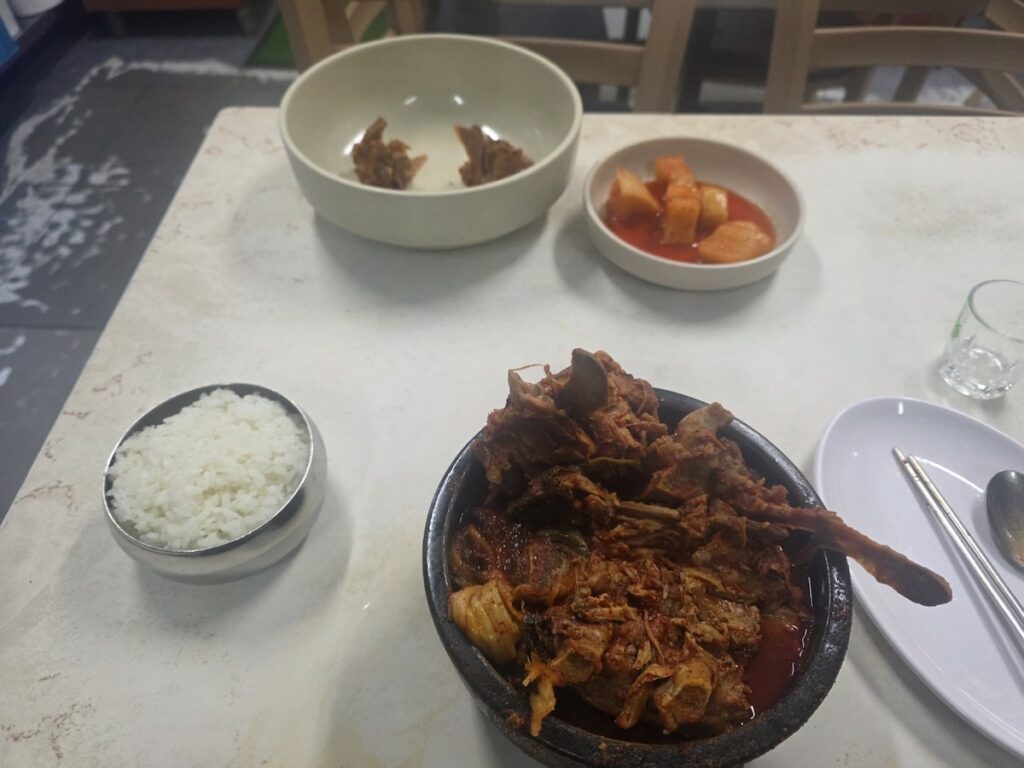
- Jokbal (족발), braised pig’s trotters. You’ll be given gloves to strip the last, best meat off the bone. No one expects you to do that with chopsticks.
- Bony or whole fish. Some people glove up to hold a fish steady and pick it apart, rather than fighting it with metal chopsticks.
- Crab, bossam, anything you assemble by hand. The glove appears the instant the food stops being a chopstick food and becomes a hand food.
There’s a quiet logic running through all of it: Koreans are completely willing to eat with their hands — they just don’t want the mess on the actual skin.
The contradiction that makes this interesting
Here’s the part that got me thinking past the plastic.
There’s an old Korean expression: 음식은 손맛이지 — eumsigeun sonmaddiji, “food is about the taste of the hand.” Sonmat, “hand taste,” is one of the warmest ideas in Korean food culture. It means the flavor a cook’s own hands bring to a dish — the grandmother mixing kimchi by hand, seasoning by feel, the intangible something that no recipe captures. For a long time, the hand was where the love and the flavor lived. Touching the food was the point.
And yet here we all are, sealing our fingers in plastic before we touch dinner.
At first that looks like a straight contradiction — the culture of “hand taste” quietly replaced by a culture of “don’t get it on your hands.” But I don’t think one killed the other. I think they’re two different hands.
The sonmat hand is the cook’s hand — the one that makes the food, in the kitchen, with love. The gloved hand is the eater’s hand — the one at a chicken-and-beer table on a Friday night, that also has to hold a phone and a cold glass and not smear sauce on a friend. The old value didn’t disappear. It just isn’t asked to do the eating anymore.
You can watch this play out on Korean TV, too. Even in mukbang and variety shows — the whole aesthetic of which is joyful, uninhibited eating — you’ll constantly see hosts snap on a glove before picking something up. Enthusiastic hand-eating and fastidious hand-protecting, at the same table, on camera, without anyone finding it odd.
What the little glove actually tells you
Korean fried chicken didn’t come from tradition. It scaled up in the 1980s and exploded after the 1997 IMF crisis, when waves of laid-off workers opened chicken shops — low startup cost, simple to run — and chimaek (chicken + maekju, beer) became the default way a nation relaxes. It’s a modern, delivery-shaped, weeknight food. Its etiquette wasn’t inherited; it was invented on the fly, fast, by millions of people eating the same sticky wings.
And what they invented was this: a way to eat enthusiastically with your hands while keeping your hands clean. The two-finger glove is that whole idea shrunk down to a piece of plastic you could miss entirely.
So the next time a set of little gloves lands on your table with the chicken, put them on — thumb and index finger, like everyone else. You’re not just keeping the sauce off. You’re taking part in a very small, very Korean answer to an old question: how do you hold onto the intimacy of eating with your hands, in a world that would really rather you didn’t get them dirty?
I ate this particular plate of chicken with friends in Seoul; the gloves, the beer, and the greasy-fingers-anyway are all from that night. If your local chicken place does the glove thing differently — or if you’ve spotted the two-finger move somewhere I haven’t — I’d love to hear about it.