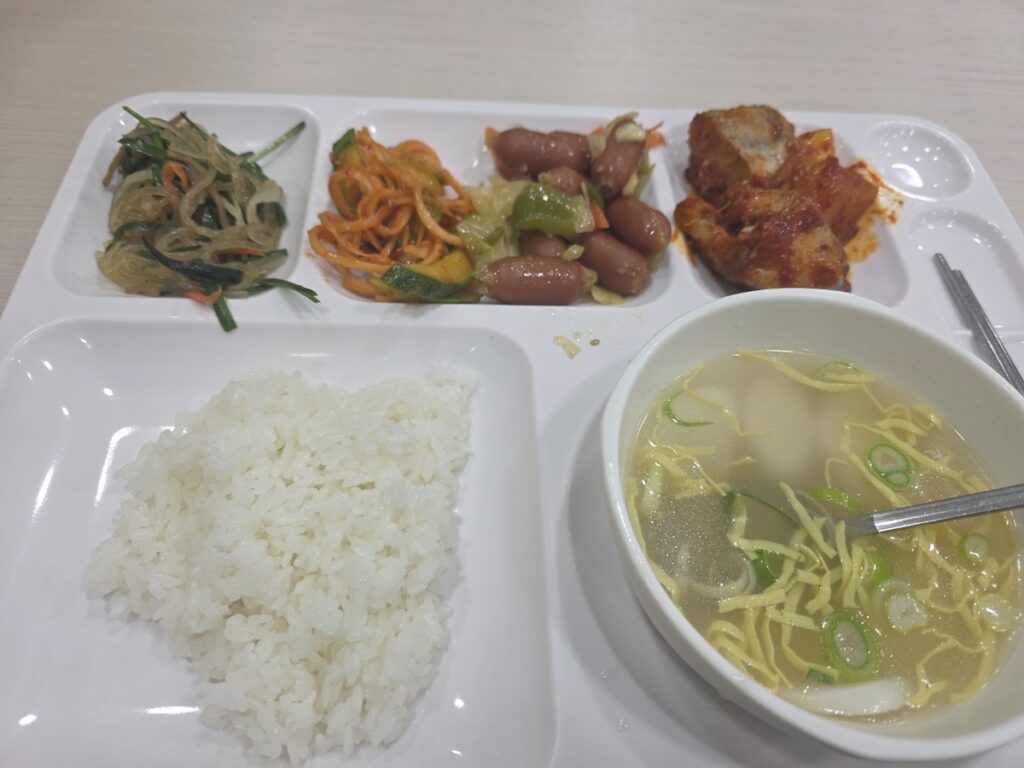
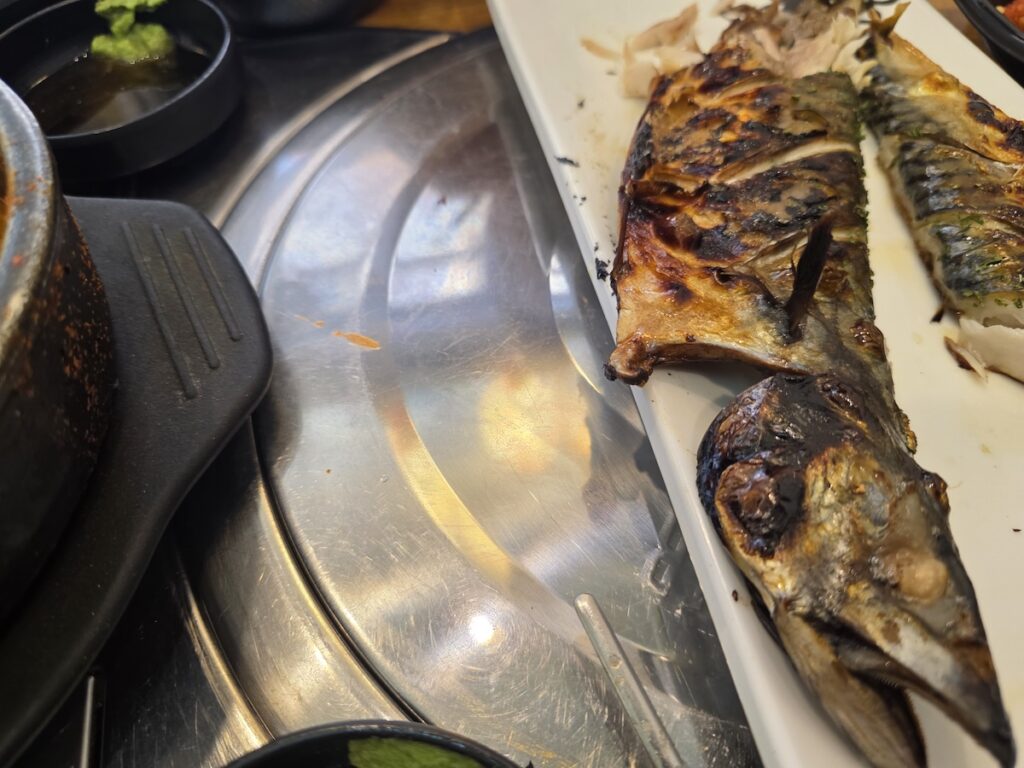
Korean grilled fish bones were not something I thought about very deeply until I had grilled mackerel and mackerel kimchi stew with my father yesterday.
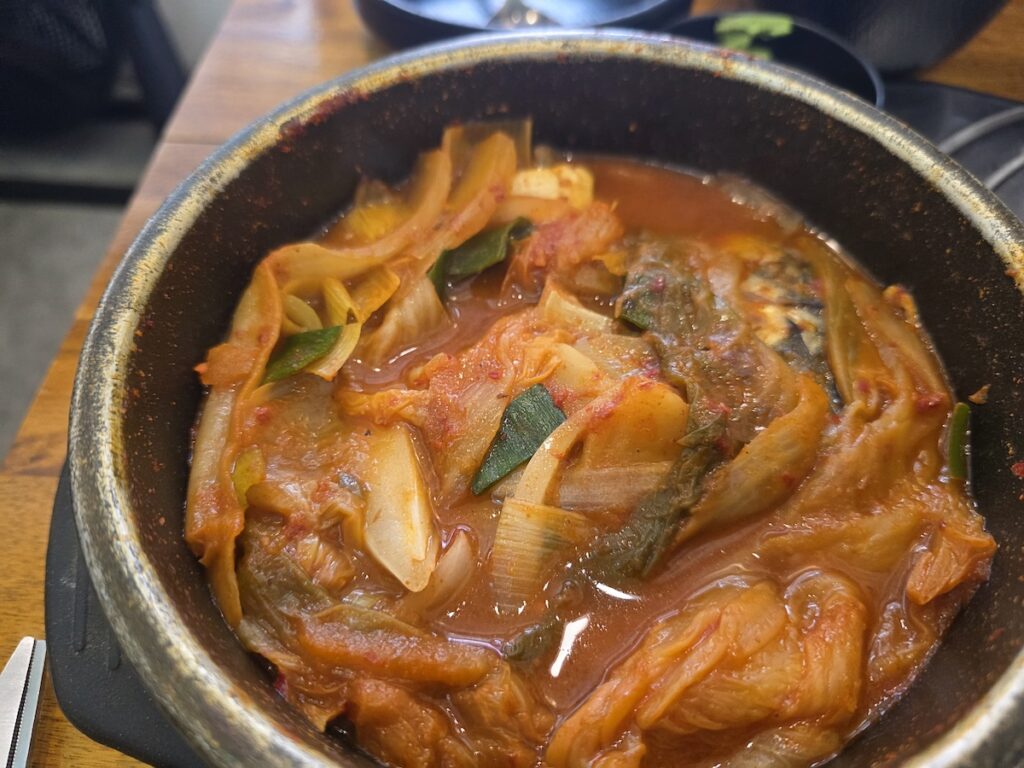
It was not a special meal. No famous restaurant, no beautiful ocean view, no dramatic travel moment. Just a normal Korean table with rice, kimchi, grilled mackerel, and a spicy braised mackerel dish where the fish had softened into the red kimchi broth.
Because I was eating with my father, I felt comfortable. I could take my time. I could separate the fish bones slowly. I could leave small pieces on the side of my plate without feeling judged. If a bit of sauce touched my fingers or if the fish broke apart messily, it did not matter.
But while eating, I suddenly thought about how different the same meal would feel with someone less familiar.
A business lunch. A formal dinner. A first date.
The fish would taste the same, but the pressure would be completely different.
In Korea, grilled fish is everyday food. Mackerel, Spanish mackerel, hairtail, yellow croaker, saury, and many other fish appear at home, in small neighborhood restaurants, in market alleys, and in simple lunch places near office buildings. But for many foreign visitors, the surprise is not the taste. It is the bones.
Quick Answer: Why Are Korean Grilled Fish Bones So Difficult for Foreigners?
Korean grilled fish bones feel difficult because fish is often served whole, split, or in large bone-in pieces rather than as a clean fillet. In many Western countries, restaurants usually remove the bones before serving, especially in casual dining. In Korea, eating around the bones is considered a normal part of the meal. It is not meant to be difficult or rude. It is just part of the food culture. Korean grilled fish bones also reveal something social: eating fish neatly takes chopstick skill, patience, and comfort at the table. That is why fish feels easy with family, but stressful with strangers.
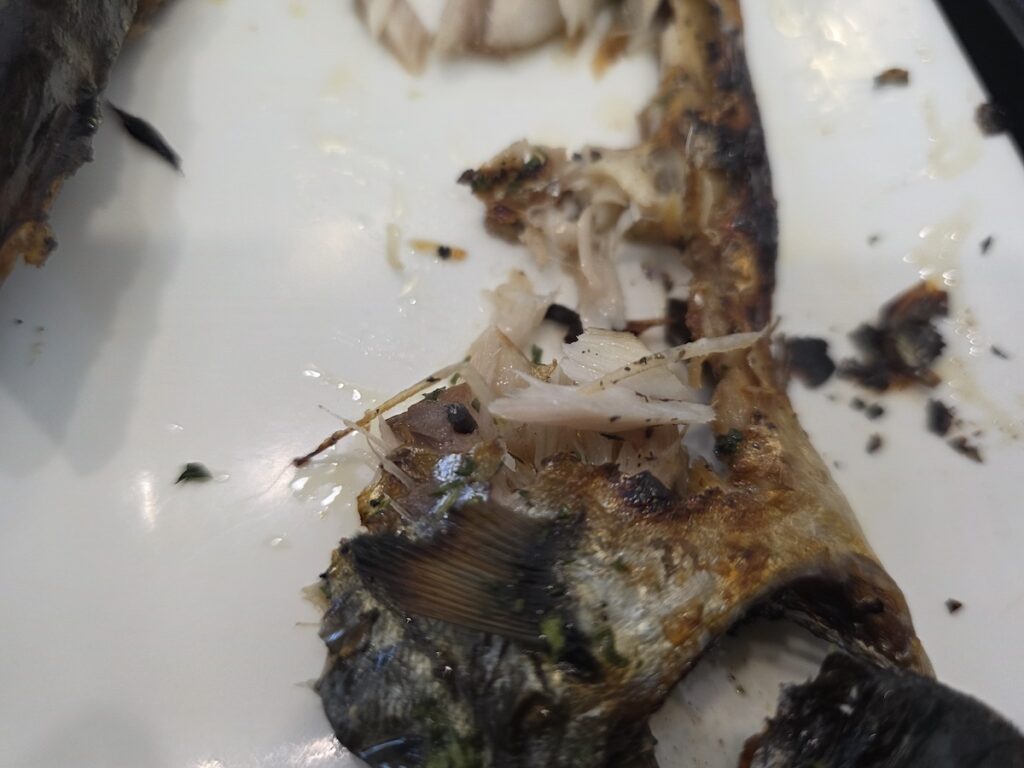
Korean Grilled Fish Bones Are Part of the Meal
For many Koreans, a fish bone is not a mistake. It is not a failure by the kitchen. It is simply part of the fish.
A grilled mackerel arrives with its skin crisp and dark in places, the flesh warm and oily, the smell strong but familiar. You use chopsticks to open the fish gently, follow the spine, lift the flesh away, and avoid the thin bones hiding near the belly or edges.
If you grew up eating this, it feels ordinary. Maybe annoying sometimes, but ordinary.
If you did not grow up eating this, it can feel like a small exam.
You look at the fish and wonder where to begin. You press the chopsticks into the flesh and suddenly the fish collapses. You try to take one clean piece, but a thin bone comes with it. You are not sure whether to put it in your mouth, remove it with chopsticks, or pretend nothing happened.
The Korean person across from you may already be halfway finished, leaving only a clean skeleton on the plate.
That difference can feel unfair.
Whole Fish Feels More Honest, But Also More Demanding
Korean food often keeps ingredients close to their original form. A crab still looks like a crab. A whole chicken soup still has bones. A fish often looks like a fish.
There is something honest about that. You can see what you are eating. The skin, the bones, the head, the tail, the texture of the flesh — nothing is hidden.
But honesty at the table can be demanding.
A boneless fillet asks very little from the person eating it. You cut it, season it, and eat it. A Korean-style grilled fish asks you to participate. You have to look carefully, use your chopsticks, understand the structure of the fish, and accept that the plate may not stay perfectly clean.
For first-time visitors, this can be one of those small Korean dining moments that feels more intense than expected.
Why Fish Is Easier at Home Than in Public
The funny thing about Korean grilled fish is that the difficulty is not only physical. It is also social.
At home, fish bones are not a big problem. Someone may place an extra small plate on the table and say, “Put the bones here.” A mother might remove the bones for a child. A father might casually separate a large piece and place it on someone else’s rice. People eat slowly. Nobody is performing.
That is why my meal with my father felt comfortable.
We were eating grilled mackerel and mackerel kimchi stew, and I did not have to think about how I looked. The stew was even more difficult than the grilled fish because the bones were hidden under kimchi, sauce, and soft fish flesh. But it did not matter. It was family food. A little mess was part of it.
In a public or formal setting, the same fish changes character.
Suddenly, you become aware of your chopsticks. You notice your plate. You wonder if you are leaving too much edible meat on the bones. You worry about accidentally biting into a sharp piece. The food is delicious, but it also demands attention.
The “Spoiled Rich Kid” Joke
In Korea, if someone leaves a lot of good fish meat around the bones, people may jokingly say something like, “You must have grown up rich.”
The meaning is not literal. It does not mean anyone is actually accusing you of being wealthy. It is a playful way of saying, “You are wasting the good parts,” or “Maybe someone always cleaned the fish for you.”
There is a similar feeling in many food cultures. People who grew up eating crab know how to get meat from the legs. People who grew up eating chicken wings know how to leave only clean bones. People who grew up eating whole fish often know how to separate the flesh neatly.
In Korea, eating fish well can quietly show that you are practical, experienced, and not too delicate about food.
But there is no need to panic. Many Koreans are not masters either. Some people are extremely neat. Some people leave a mess. Some people love fish but hate dealing with bones. The difference is that Koreans are usually familiar with the situation, even when they are not very good at it.
Korea vs Western Countries: Why the Fish Feels Different
Many Western visitors are used to fish that arrives boneless, skinless, or at least mostly cleaned. Of course, whole fish exists in Europe and North America too, especially in seafood restaurants or coastal areas. But in everyday casual dining, the fish is often made easier for the customer before it reaches the table.
Korea is different because bone-in fish appears in very normal meals.
You do not need to go to a fancy seafood restaurant. You might find grilled mackerel in a small lunch place near a subway station, in a market restaurant, in a department store food court, or in a home-style 백반 restaurant where office workers eat quickly during lunch.
| Dining Situation | Many Western Countries | Korea |
|---|---|---|
| Casual fish meal | Often served as a fillet | Often served bone-in |
| Customer expectation | Easy to cut and eat | Some effort is normal |
| Bones on the plate | May feel like a problem | Expected and accepted |
| Skill needed | Fork and knife handling | Chopstick control and patience |
| Social feeling | Usually low pressure | Can feel personal or revealing |
| Best setting for beginners | Any casual restaurant | Family-style or relaxed restaurant |
This is why Korean fish can surprise travelers. It is not that the cooking is careless. It is that the idea of convenience is different.
In some places, convenience means the kitchen removes every obstacle. In Korea, especially with traditional home-style food, convenience may mean the fish is cooked well, seasoned properly, and served hot. The eating part is still your job.
The First-Date Problem with Korean Grilled Fish Bones
There is a reason a grilled fish restaurant is not the safest choice for a first date in Korea.
It is not because the food is bad. Actually, grilled fish can be wonderful. A good piece of mackerel with hot rice and kimchi can feel more satisfying than a trendy pasta place in Seongsu or a crowded café in Hongdae.
But first dates are not only about taste. They are about comfort, appearance, and rhythm.
Fish interrupts the rhythm.
You have to look down often. You have to concentrate. You may need to remove a bone from your mouth carefully. Your plate may look messy. The smell can stay on your clothes. If the restaurant is small and smoky, your hair may carry the scent of grilled fish afterward.
None of this is terrible with someone you know well.
With someone you just met, it can be too much.
Food That Reveals Too Much
Some foods are private even when eaten in public.
Korean grilled fish is one of them. So are crab, spicy bone soup, chicken feet, and very saucy noodles. They are delicious, but they reveal how you eat. Are you careful? Are you messy? Are you confident? Are you nervous? Do you know where to place the bones? Do you talk while eating or disappear into concentration?
That is why grilled fish feels better with family, old friends, or someone you already feel comfortable with.
A first date usually needs food that allows conversation to move easily. Fish demands silence at exactly the wrong moment.
Imagine trying to make a charming first impression while quietly fighting a mackerel spine.
That is not romance. That is survival.
Mackerel, Spanish Mackerel, Hairtail: Not All Fish Are the Same
If you are visiting Korea and want to try fish, it helps to know that different fish have different levels of difficulty.
Mackerel, or 고등어, is one of the most common. It is oily, flavorful, and often grilled with salt. It can have a strong smell, but when cooked well, it is rich and satisfying. The bones are manageable once you understand the structure, but small bones can still surprise you.
Spanish mackerel, or 삼치, is often softer and milder. Many people find it easier to eat than mackerel because the flesh separates nicely. It is a good choice if you want Korean grilled fish but feel nervous about a stronger taste.
Hairtail, or 갈치, is beautiful and difficult in its own way. It has a long silver body and a delicate texture. In Jeju, large hairtail dishes are famous, and some restaurants remove the bones at the table with impressive skill. Foreign visitors often look amazed when the staff separates the long fish so cleanly. It almost feels like a performance, but for Koreans, it is also a sign of experience.
Yellow croaker, or 조기, is smaller and common in home meals and holiday tables. It tastes good, but because it is smaller, it can require careful eating.
Grilled Fish vs Braised Fish
Grilled fish is usually easier because the shape is clear. You can see the spine. You can separate the top layer of flesh, remove the main bone, and continue.
Braised fish is harder.
In dishes like 고등어김치조림, the fish sits in spicy sauce with aged kimchi, onion, radish, or other vegetables. The flavor is deeper, but the bones are harder to see. The fish becomes soft, and everything mixes together.
This was exactly what I felt while eating with my father. The grilled mackerel was direct. The mackerel kimchi stew was delicious but less predictable. I had to slow down.
For a foreign visitor, braised fish may taste more exciting, but grilled fish is probably a better place to start.
How to Eat Korean Fish Without Feeling Embarrassed
The best advice is simple: slow down.
Korean meals can sometimes feel fast, especially at lunch restaurants where people eat, pay, and leave within 30 minutes. But fish does not reward speed. If you rush, you will either miss good meat or bite into bones.
Start by looking at the fish before attacking it. Notice where the spine probably is. With chopsticks, gently open the flesh along the center. Take small pieces. Do not try to make one perfect move.
If you find a bone in your mouth, do not panic. Koreans deal with this too. Quietly remove it with chopsticks or a tissue, depending on the setting. It is not elegant, but it is normal.
If the restaurant gives you a small empty plate, use it for bones. If not, place the bones neatly on the side of your main plate. Try not to mix bones into shared dishes.
What Not to Worry About Too Much
Do not worry if you cannot make the fish skeleton perfectly clean. Most people are not watching as closely as you think.
Do not worry if you leave some meat behind. You may receive a small joke from a close Korean friend, but in most situations, nobody will seriously care.
Do not worry if you ask for help. In Korea, food is often shared and assisted. Someone older or more experienced may naturally separate a good piece and place it on your rice or plate. This is not treating you like a child. It can be a small gesture of care.
And if you are truly uncomfortable, choose a different dish. There is no rule that says you must master fish bones to enjoy Korea.
Why This Small Dining Skill Matters
The deeper point is not really about fish.
It is about how food teaches you what a culture considers normal.
In Korea, many meals require small techniques. Wrapping grilled meat in lettuce. Cutting noodles with scissors. Mixing rice into soup. Sharing side dishes without touching everything with your chopsticks. Pouring drinks for others. Waiting for the older person to start in certain settings.
Fish bones belong to this same world.
They are small, practical, and easy to ignore until you are sitting at the table.
For foreign travelers, these moments can feel confusing because nobody announces the rule. There is no sign on the wall explaining how to eat grilled mackerel politely. You simply watch other people and learn.
That is very Korean in its own way.
Much of daily life here is learned through observation. How people stand on the subway escalator. How they order at a kiosk. How they separate trash. How they share food. How they remove fish bones without making a big deal out of it.
The Comfort of Eating Fish With Family
The meal with my father reminded me that some foods are not only about flavor. They are about who you are eating with.
A grilled mackerel on the table can feel like a test with strangers. With family, it becomes background noise. You talk, eat, separate bones, reach for kimchi, add rice, and continue. Nobody cares if the fish breaks apart badly. Nobody is measuring your chopstick skill.
That comfort is part of why fish remains such a familiar food in Korea.
It belongs to ordinary tables. It smells like lunch at home, like a small restaurant near an apartment complex, like a simple meal after work. It is not polished. It is not designed for perfect photos. It asks for your hands, your attention, and sometimes your patience.
For a first-time visitor, that can be frustrating.
But it can also be one of the most honest food experiences in Korea.
Should Foreign Visitors Try Korean Grilled Fish?
Yes, but choose the right moment.
Do not make it your first meal after landing if you are tired, hungry, and still learning how to use metal chopsticks. Do not choose it for a first date unless both people are very relaxed. Do not order a complicated braised fish dish with important business guests unless you already know the atmosphere.
Try it when you have time.
A small Korean 백반 restaurant is a good place. So is a casual seafood restaurant near a traditional market. In Seoul, neighborhoods with older residential streets often have simple grilled fish places that feel more local than fashionable. You might see office workers eating quickly, older couples sharing stew, or a restaurant owner turning fish on a grill near the entrance.
Order rice. Eat with kimchi. Take your time.
If the fish is salty, balance it with plain rice. If it is oily, eat it with kimchi or a small side dish. If there is soup, sip it between bites. Korean fish is rarely meant to stand alone. It is part of a table.
That table is the point.
Conclusion: The Bones Are Part of the Story
Korean grilled fish bones can feel surprisingly difficult the first time you meet them. They make you slow down. They make you look carefully. They make you realize that eating is not always as simple as putting food in your mouth.
But they also show something warm and real about Korea.
Fish with bones belongs to family meals, neighborhood restaurants, Jeju seafood tables, office lunches, and quiet dinners with parents. It can be awkward with strangers and comforting with people you love. It can make foreigners nervous, but it can also help them understand Korean dining more deeply.
The goal is not to become a perfect fish-bone master.
The goal is to understand that in Korea, some meals ask you to participate. You do not just receive the food. You handle it, adjust to it, and slowly learn the small habits around it.
And after a while, maybe you will look down at your plate, see a clean fish skeleton, and feel a tiny bit proud.
Not because anyone else noticed.
Because now you understand the meal a little better.