You’ll smell Korean dried squid before you understand it.
It’s late. The first bar is behind you, the second one just got loud, and a plate of pale, shredded squid lands on the table. Nobody ordered it on purpose. It’s just there, the way it’s always there. Someone tears off a strip and hands it to you without looking. The beer arrives a second later.
If you’ve spent any time in Korea, you’ve met this snack. On the subway. In a movie theater. In a friend’s apartment at 1 a.m. And the question most foreigners are quietly asking is the same one: why squid, why dried, and why does the whole room now smell like the sea?
This is the answer. The short version and the long version. Both sides, the good and the slightly embarrassing.
Quick Answer
Korean dried squid (마른 오징어, mareun ojingeo) is one of the most common drinking snacks in Korea. It’s chewy, salty, faintly sweet, and high in protein. Koreans eat it most at the “second round” of a night out, usually with beer. The classic dip is mayonnaise mixed with gochujang. It’s affordable, lasts forever, and is genuinely nutritious. The downsides are real too: the smell lingers, it gets stuck in your teeth, and it’s a bad idea on a first date.
What “Korean dried squid” actually means
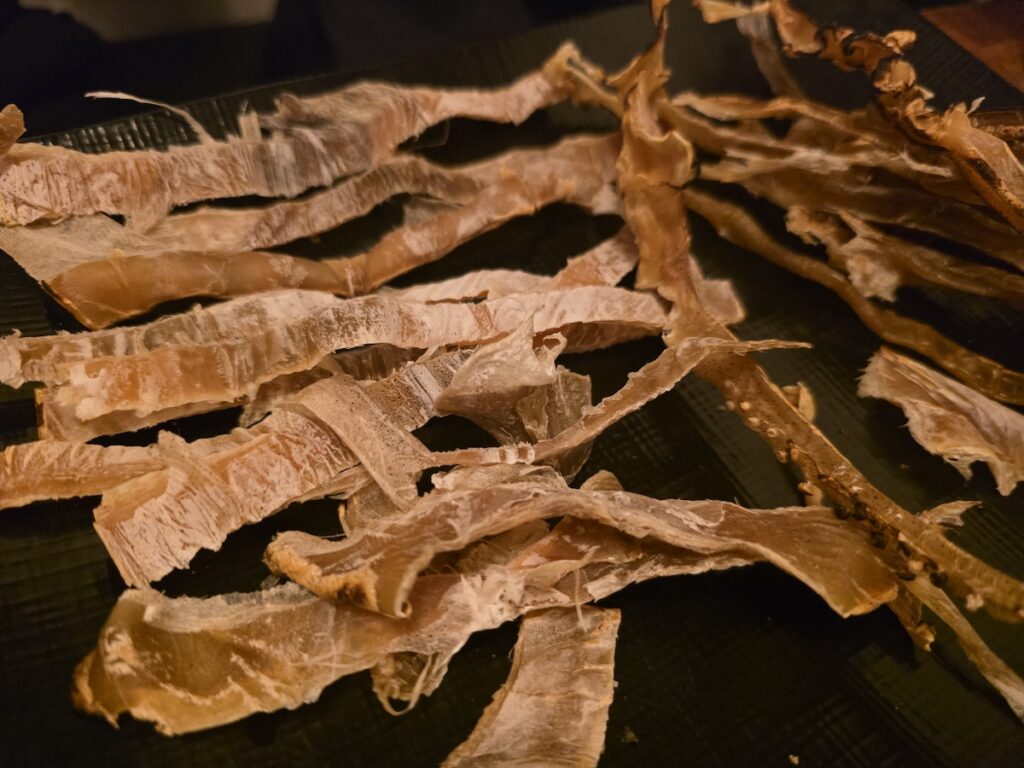
The word you’ll hear is ojingeo (오징어), which just means squid. Dried squid is mareun ojingeo. But the category is wider than one snack, and that confuses people early on.
There’s the whole dried squid, flattened and stiff, sold hanging in markets and at convenience stores. You tear it by hand. It fights back. There’s jinmichae (진미채), which is squid shredded into soft, sweet-and-spicy threads, often a side dish in lunchboxes. There’s grilled dried squid, warmed over a flame until it puffs and softens. And there’s fresh squid, grilled or boiled, which is a different food in a different setting entirely.
When a Korean says they want ojingeo with their beer, they almost always mean the dried kind. The flavor is concentrated. Drying pulls the water out and leaves something denser and more savory than fresh squid ever tastes. It’s the difference between a grape and a raisin.
For a foreigner, the honest first reaction is often confusion, then suspicion, then quiet addiction. The texture is the barrier. It does not give up easily. You chew, and chew, and the flavor keeps arriving in waves. That slowness is part of the point. This is not a snack you finish. It’s a snack you keep returning to over a long conversation.
The 2-cha ritual: why squid shows up at the second bar
To understand the snack, you have to understand the night it belongs to.
A Korean night out runs in rounds. Dinner and drinks at the first place is il-cha (1차). Then the group moves. The second place is i-cha (2차). Sometimes there’s a 3차, occasionally a 4차, and at that point you should probably text someone you trust. Each round has its own mood. The first is about food. The second is lighter, later, and built around drinking and talking.
Squid lives at the 2차. By then nobody is hungry, exactly. They want something to keep their hands and mouths busy while the conversation stretches out. Dried squid is perfect for this. It’s cheap. It lasts. You can pick at it for an hour without filling up. It pairs with beer instead of competing with it.
This is also where the social logic clicks into place. Korean drinking culture is communal. You pour for others, not yourself. Food on the table is shared by default. A plate of torn squid in the middle of the table is something everyone reaches into, and that small repeated gesture, tearing a piece and passing it, is part of how the group stays connected as the night goes on. If you want the broader context for how these group rituals work, it’s worth reading our guide to Korean social culture for foreigners.
The flip side: 2차 culture can be a lot. The rounds add up, the bill grows, and the squid is the cheapest thing on the table by far. Nobody is getting rich selling it. It’s there to keep the night moving, not to be the main event.
Squid, beer, and the peanut question
Ask a Korean to picture the perfect beer snack and there’s a good chance they’ll picture this exact plate: dried squid and peanuts.
The pairing is so common it has a rhythm to it. Beer is cold and slightly bitter. Squid is warm in flavor, salty, and chewy. The peanuts add crunch and fat. You alternate. Sip, tear, chew, crack a peanut, sip again. It’s a loop that can run for hours.
The category word here is anju (안주), meaning food eaten specifically with alcohol. Anju is its own world in Korea, and dried squid sits near the center of it. It’s the default. The thing the bar already has behind the counter. If you sit down and order beer and the staff asks if you want anju, squid is almost always one of the first suggestions.
There’s a practical reason the pairing endures, beyond taste. Salt makes you thirsty, and thirst sells beer. Bars know this. The squid is not an accident on the menu. But that’s a cynical way to read something that’s also just genuinely good. The salt-and-bitter contrast works. People have been doing it for generations because it tastes right, not only because a bar owner wanted to move another bottle.
A note for newcomers: the smell of dried squid in a crowded hof (Korean beer bar) is part of the atmosphere. You stop noticing it after twenty minutes. Your jacket will notice it tomorrow.
The sauce nobody told you about: mayo and gochujang
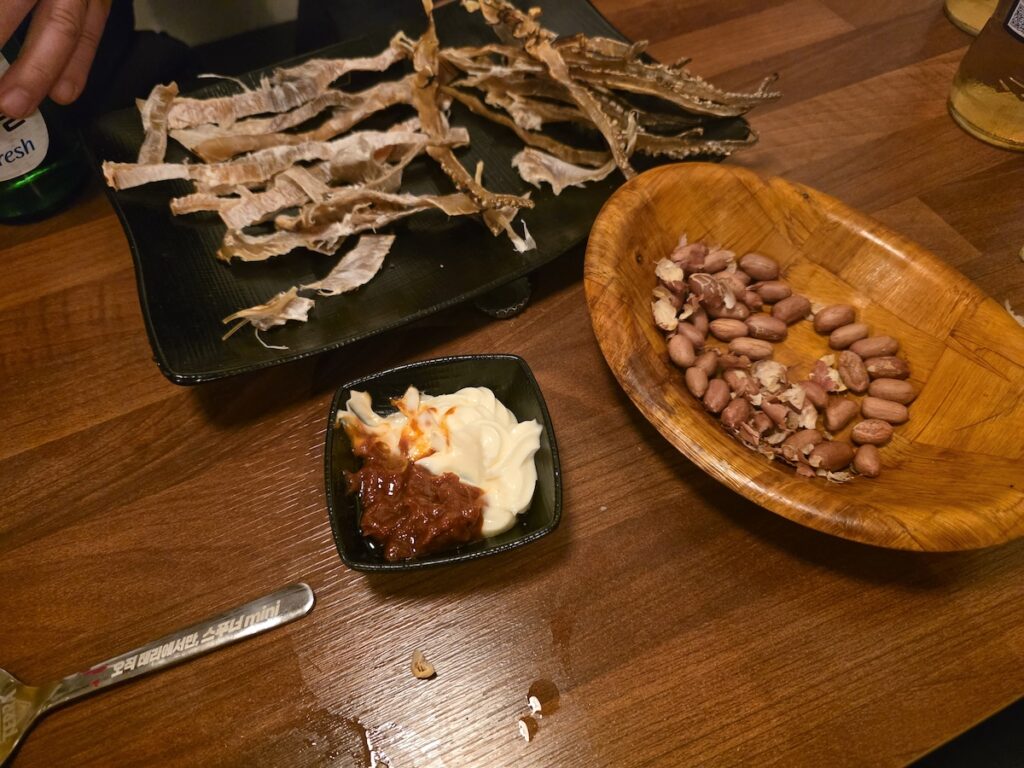
Here’s the detail that converts skeptics.
Dried squid on its own is salty and a little one-note. The fix is a dipping sauce that sounds wrong and tastes right: mayonnaise mixed with gochujang, the fermented red chili paste. Roughly two parts mayo to one part gochujang, though everyone has an opinion. Some people add a touch of sugar. Some add a squeeze of nothing at all.
The logic is simple once you taste it. The mayo is cool, rich, and slightly tangy. The gochujang is spicy, deep, and fermented. Together they coat the squid, soften the saltiness, and add a layer that the plain snack is missing. You dip the torn strip, you chew, and suddenly the whole thing makes sense.
This sauce is not fancy. You’ll see it served in a tiny dish at bars, or mixed at home in about thirty seconds. Convenience stores even sell squid with little sauce packets attached. It’s the kind of small, unglamorous food hack that you only learn by sitting at enough tables with people who grew up doing it.
If you’re trying dried squid for the first time and you don’t like it plain, don’t give up there. Get the sauce. The plain version and the sauced version are almost two different foods. Plenty of foreigners decide they dislike dried squid after one dry, unsauced strip, which is a bit like judging chips by eating one without salt.
Comparison: the squid snacks you’ll actually meet
Not all squid snacks are the same, and knowing the difference saves you from ordering something you didn’t want. Here’s the practical breakdown.
| Snack | What it is | Texture | Where you’ll see it | Smell level |
|---|---|---|---|---|
| Mareun ojingeo (dried squid) | Whole squid, dried stiff | Very chewy, dense | Bars, convenience stores, markets | High |
| Grilled dried squid | Dried squid warmed over flame | Chewy but softer, puffed | Street stalls, bars | High |
| Jinmichae | Shredded, seasoned squid threads | Soft, sweet-spicy | Side dish, lunchboxes, rice bowls | Low to medium |
| Fresh grilled squid | Whole fresh squid, grilled | Tender, bouncy | Coastal towns, pojangmacha | Medium |
| Butter-grilled squid | Dried squid grilled with butter | Rich, soft, savory | Older-style bars | High |
The two you’ll run into most as a traveler are mareun ojingeo at bars and jinmichae at meals. If someone hands you a soft, slightly sweet red tangle of squid threads with your rice, that’s jinmichae, and it’s a gentler introduction than the full dried slab. If a foreigner in your group is squeamish, point them there first.
The smell problem: movie theaters, subways, and shared air
Now the honest part.
Dried squid smells. Strongly. And the smell does not stay where you left it. It moves into fabric, into elevators, into the recycled air of a movie theater. For years, eating dried squid at the cinema was completely normal in Korea. It was a default snack, sold right there, as ordinary as popcorn.
That has shifted. In the last decade, Koreans have grown noticeably more conscious of strong food smells in shared spaces. You’ll see it on the subway, where eating anything pungent now draws looks. You’ll see it in newer cinemas, where the squid-and-beer combo of the past has quietly faded. The change tracks a broader trend toward smell etiquette in crowded public places, the same instinct that makes people careful about perfume or food on a packed train.
This doesn’t mean squid is banned or shameful. It means the context narrowed. Dried squid is still completely welcome at a bar, at home, on a fishing trip, at a baseball game. It’s just less welcome pressed up against a stranger’s shoulder in a sealed train car. For a foreigner, the safe rule is simple: squid belongs in open or already-loud spaces, not in quiet, enclosed, shared ones.
If you’re curious why Koreans are so attuned to public-space behavior in the first place, our piece on why Seoul feels so safe gets at the same underlying social awareness, the sense of being one person among many.
The balanced view: the smell is a real downside, and pretending otherwise helps no one. But it’s also inseparable from the appeal. The thing that makes your jacket smell tomorrow is the same thing that makes the squid taste like the ocean tonight.
Your teeth are going to be involved
Let’s talk about the part of your mouth that does the work.
Dried squid is tough. That’s not a flaw, it’s the whole identity of the snack. But toughness has consequences. The fibers get into the gaps between your teeth and stay there. Anyone who eats dried squid regularly knows the feeling of running their tongue along their teeth an hour later and finding a stubborn thread that refuses to leave.
For your teeth, this cuts both ways. On one hand, the heavy chewing is not gentle. If you have dental work, weak enamel, crowns, or anything fragile, dried squid is a genuine risk. People crack fillings on it. The harder, drier pieces are the worst offenders. Older Koreans will often soften theirs by grilling first, partly for flavor and partly to spare their teeth.
On the other hand, the act of chewing produces saliva, and saliva is one of your mouth’s natural defenses. The bigger dental issue isn’t the chewing itself but the food trapped afterward, sitting against the gumline. Stuck protein is something you want to clear out, not leave overnight.
The practical advice is unglamorous. Keep dental floss or a few interdental picks with you if you eat dried squid often. Korean convenience stores and pharmacies stock them everywhere. A quick floss after a 2차 saves you discomfort and protects the gaps where squid loves to hide. It’s a small habit, and your dentist will quietly thank you.
The date warning: when to avoid it
This follows directly from the last two sections, and it deserves its own moment, because foreigners learn it the hard way.
Do not eat dried squid on a first date.
The math is simple. Squid smell lingers on your breath and clothes. Squid fibers lodge in your teeth and show when you smile. Neither of these is the impression you want to make across a small table from someone you’re trying to charm. Koreans understand this instinctively. You’ll notice that early dates tend toward cafes, light meals, and snacks that don’t announce themselves. Squid is a later-stage food. It’s for the friends you’re already comfortable with, the group that’s seen you at your worst, the relationship that’s past the point of impressing anyone.
There’s something a little sweet in that, actually. Dried squid is a comfortable-people food. It’s what you eat when you’ve stopped performing. The fact that it’s a terrible date snack is the same fact that makes it a great old-friends snack. You only tear into a shared plate of squid with people you don’t need to perform for.
So the rule stands, and it’s not a joke. Save the squid for round two, with the people who already like you.
Is Korean dried squid actually good for you?
Here’s where the snack earns more respect than its reputation suggests.
Dried squid is high in protein and low in fat. Squid is naturally lean, and drying concentrates the protein further, so a small amount delivers a meaningful hit. It also contains taurine, an amino acid linked to heart and muscle function, which is part of why squid has a reputation in Korea as a recovery food. There’s a reasonable nutritional argument that, as drinking snacks go, dried squid is one of the better choices. It beats fried chicken and chips on protein and fat by a wide margin. You can confirm the basic numbers for squid through a reliable database like the USDA FoodData Central.
| Nutrition snapshot (dried squid) | Notes |
|---|---|
| Protein | High — the main reason it’s considered a “good” snack |
| Fat | Low — squid is naturally lean |
| Sodium | High — especially in seasoned or convenience-store versions |
| Cholesterol | Notably high — a real consideration for some people |
| Taurine | Present — linked to its recovery-food reputation |
| Purines | Present — relevant if you’re prone to gout |
But balance, as always. The downsides are not small. Dried squid is high in sodium, sometimes very high, especially the pre-seasoned packaged kind. It’s also relatively high in cholesterol, which matters for people watching theirs. And squid contains purines, so anyone managing gout should be cautious. The protein is excellent, but you’re paying for it in salt.
The fair conclusion: dried squid is a genuinely decent snack in moderation, and a much smarter beer companion than most of the alternatives. Eaten by the bagful, every night, with three beers, it stops being a health food and starts being a sodium delivery system. Like most things in Korean drinking culture, the snack is fine. The pace is what gets you.
A note on taking it home
Dried squid travels well, which is why it ends up in a lot of suitcases. It’s shelf-stable, light, and unmistakably Korean. Plenty of visitors buy a few packs as gifts.
Two honest cautions. First, the smell. A vacuum-sealed pack is fine, but once it’s open it announces itself, and not everyone back home will be charmed. Second, customs. Dried seafood can run into import restrictions depending on the country, so check your destination’s rules before you load up. If you’re putting together a haul of edible souvenirs, our guide to the best Korean souvenirs in Seoul covers what actually makes it home in one piece and what doesn’t.
For most travelers, though, the better souvenir isn’t the squid itself. It’s the memory of the table it came on. You can buy dried squid in a lot of places. The 2차, the shared plate, the mayo-gochujang dish, the friend tearing off a strip and passing it without a word — that part doesn’t fit in a suitcase.
Conclusion: it was never really about the squid
After enough years here, you stop seeing dried squid as a food and start seeing it as a signal.
It tells you the night has moved to its second act. It tells you the people at the table have relaxed, that nobody’s performing anymore, that the conversation is the main course and the squid is just there to keep your hands busy. The smell, the chewing, the bits in your teeth, the sauce, the beer alongside it, all of it is the texture of a particular kind of Korean evening. Unhurried. Communal. A little messy.
You don’t have to love the taste. Plenty of foreigners never fully do, and that’s a fair verdict. But it’s worth understanding what you’re being handed when that pale, shredded plate arrives. It’s not really a snack. It’s an invitation to stay a while longer, slow down, and tear off a piece with everyone else.
Take the sauce, though. The sauce is non-negotiable.