Myeongdong seafood pancake was not what I expected to eat with my father on a hot day in central Seoul.
My mother had gone on a trip to Taiwan, so my father and I were left at home together in that slightly awkward father-and-son silence that many people probably understand. We were not fighting. We were not uncomfortable in a serious way. It was just quiet. Too quiet.
My father used to work inside Seoul’s old city walls when he was younger, around the areas Koreans sometimes call the Four Great Gates of Seoul. Places like Seoul Station, Jongno, Euljiro, and Myeongdong were not just names on a subway map to him. They were part of his working years, part of the Seoul he remembered before so many buildings changed their faces.
So we went out.
We walked around Seoul Station, Jongno, Euljiro, and eventually Myeongdong. It was hot, the kind of Seoul heat that comes up from the pavement and makes every crosswalk feel longer than it is. I suggested we get an iced Americano. It felt like the obvious answer. In Seoul, when you are tired, hot, and surrounded by cafés, iced Americano is almost a survival drink.
But my father said, almost casually, “Let’s have a glass of makgeolli instead.”
And honestly, I got nervous.
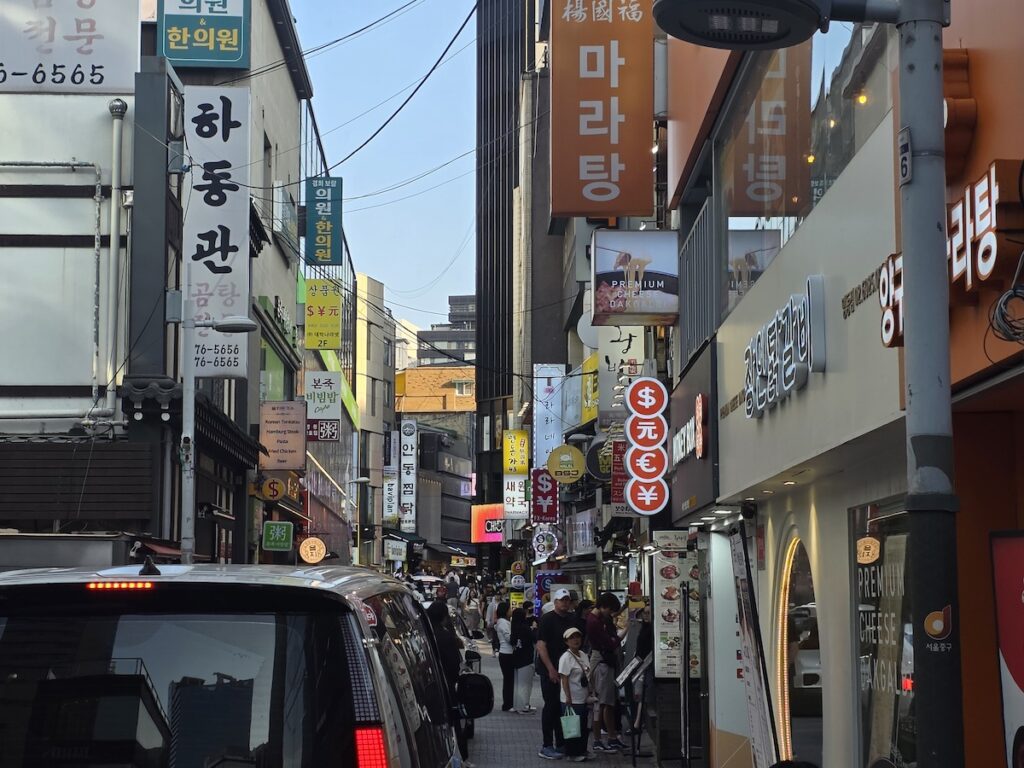
We were in Myeongdong. Foreign tourists were everywhere. That usually makes me think one thing first: this meal might be expensive.
Quick Answer: Is Myeongdong Seafood Pancake Worth Trying?
Yes, Myeongdong seafood pancake can be worth trying if you choose the right kind of place. It may cost more than in a local neighborhood restaurant, but paired with makgeolli, it can feel more satisfying than sitting in a crowded café with coffee and cake. A seafood pancake usually includes green onion, squid, shrimp, sometimes clam or mussel pieces, and a crisp egg-and-flour batter. The key is to choose a busy restaurant where ingredients move quickly, especially because seafood should be fresh. In hot weather, this simple pairing can feel surprisingly refreshing.
Why I Was Nervous About Eating in Myeongdong
Myeongdong is complicated.
For first-time visitors, it is exciting. Bright signs, cosmetics shops, street food, currency exchange booths, hotel entrances, tour groups, shopping bags, and people speaking different languages on every corner. It is one of those places where you can feel Seoul trying very hard to be international.
But for a local, or someone who has lived in Seoul for a long time, Myeongdong can also make you cautious.
When a neighborhood becomes popular with tourists, prices often become harder to trust. Not always, of course. There are still honest restaurants, old places, decent meals, and good finds. But there is always that small fear of paying too much for something average.
So when my father said he wanted makgeolli, I had two thoughts at the same time.
The first was warm: he wants to remember old Seoul.
The second was practical: please, let’s not get ripped off in Myeongdong.
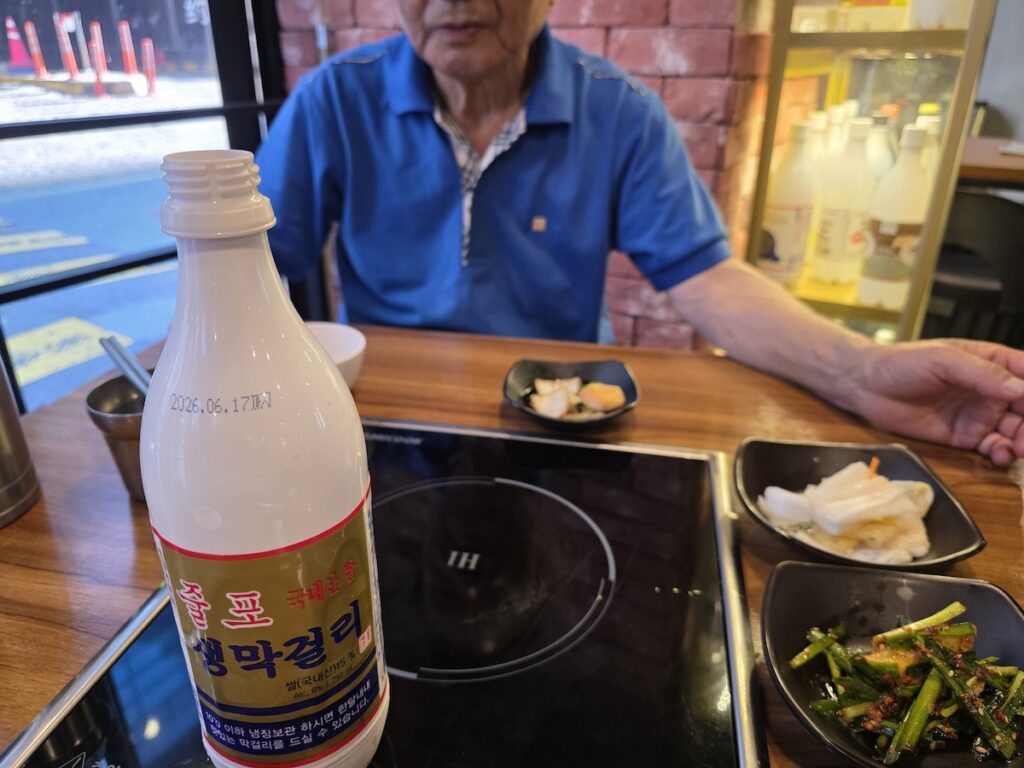
We walked into a place that looked like a traditional Korean drinking spot. Not too fancy, not too polished. The kind of place where wooden tables, metal bowls, and slightly dark lighting make you feel like makgeolli belongs there more than coffee ever could.
We ordered seafood pancake.
I remember the price as around 26,000 won. Not cheap. In a normal neighborhood, you might expect a lower price depending on the restaurant. But this was Myeongdong, and I had already prepared myself emotionally for tourist-area pricing.
Then the pancake arrived.
And we both felt better.
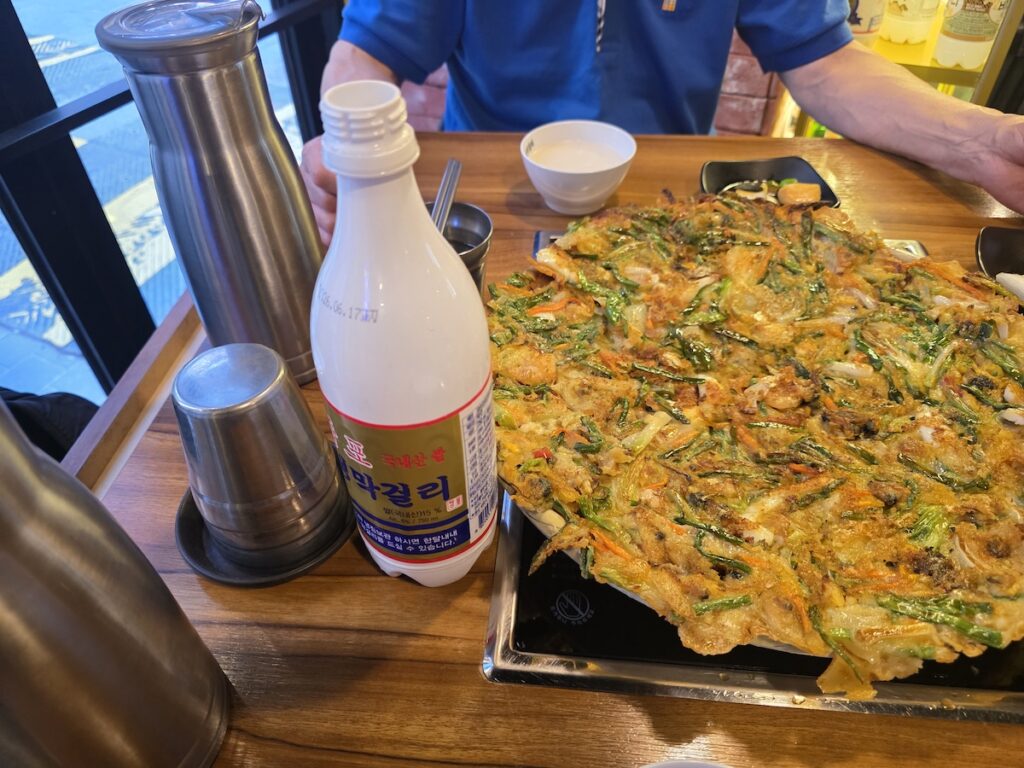
It was big.
That one detail changed the mood immediately.
The Moment the Seafood Pancake Arrives
A good Korean seafood pancake has a way of calming the table.
Before it arrives, you are checking the menu, comparing prices, wondering if you made a mistake. Then the plate lands in front of you, wide and hot, with edges that look slightly crisp and a smell that is part green onion, part oil, part sea.
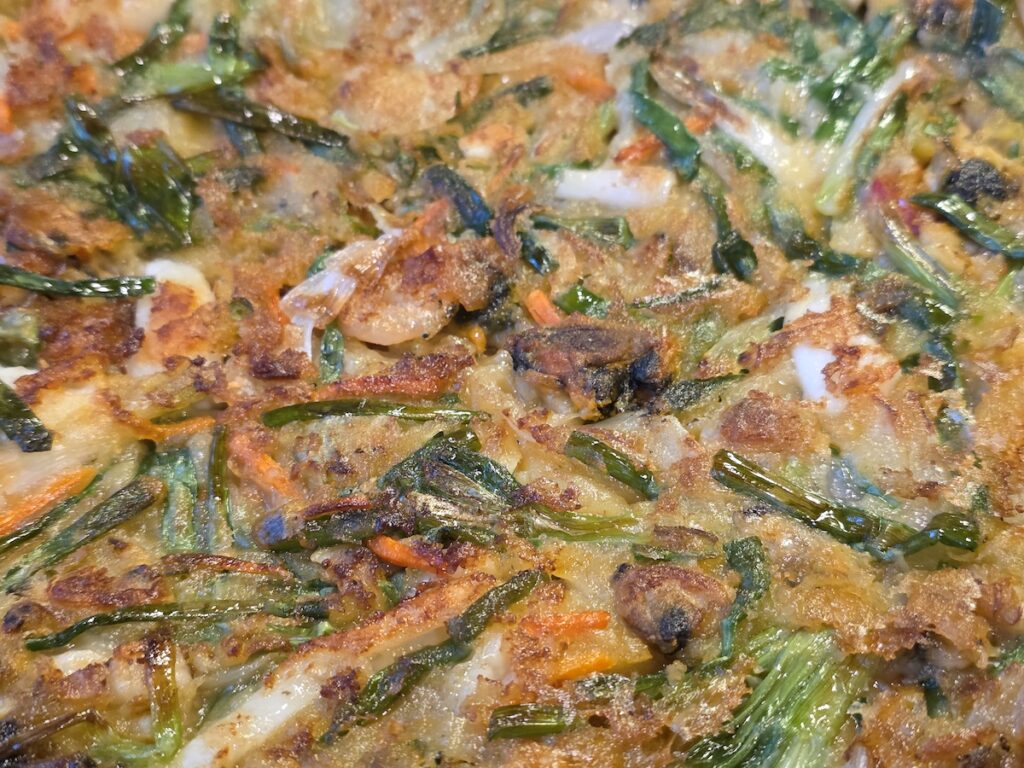
The pancake we had was thin enough to feel easy to eat, but large enough to make the price feel less painful. There was that familiar golden surface, with green onion running through it and bits of seafood hiding inside the batter. It was not a tiny tourist plate. It looked like real food.
That is when my nervousness disappeared.
My father seemed pleased too. There is a very specific happiness that happens when an older Korean man gets makgeolli and pajeon on the table. It is not loud happiness. It is more like the body relaxes. The shoulders drop. The conversation becomes easier.
Suddenly, the hot day did not feel so annoying.
What Is Usually Inside Korean Seafood Pancake?
Korean seafood pancake is usually called haemul pajeon, or 해물파전.
“Haemul” means seafood. “Pa” means green onion or scallion. “Jeon” refers to a pan-fried dish, usually made with a light batter and ingredients pressed together on a hot pan.
The exact ingredients change by restaurant, but a typical seafood pancake may include:
| Ingredient | What It Adds |
|---|---|
| Green onion or scallion | Freshness, sweetness, and the main body of the pancake |
| Squid | Chewy texture and a clear seafood flavor |
| Shrimp | Sweetness and a familiar seafood taste for visitors |
| Clam or mussel pieces | Deeper ocean flavor, when included |
| Egg | Richness and color |
| Flour or pancake batter | Holds everything together |
| Chili slices | A little heat and color |
| Soy-vinegar dipping sauce | Saltiness, acidity, and balance |
The best versions are not too thick. If a seafood pancake is too doughy, it becomes heavy quickly. The better ones have crisp edges, soft middle parts, and enough seafood to remind you that this is not just an onion pancake pretending to be special.
It does not need to be luxurious. It just needs balance.
Makgeolli: Rice, Earth, and a Cold Bowl on a Hot Day
Makgeolli is often translated as Korean rice wine, but that translation does not fully capture the feeling of drinking it.
It is cloudy, lightly sweet, slightly sour, and low enough in alcohol that it feels casual rather than serious. Some bottles are fizzy. Some are smoother. Some taste rustic. Some modern brands are cleaner and almost dessert-like. But the ordinary makgeolli you find in many restaurants still carries a very Korean feeling: simple, white, made from rice, and connected to the ground.
Rice comes from the land.
Seafood comes from the sea.
That is why makgeolli and seafood pancake make such a pleasing pair. One feels earthy and cloudy. The other smells like green onion, hot oil, and the ocean. Together, it is land and sea on a small table in Myeongdong.
There is also a practical reason they work well together. The pancake is oily, salty, and savory. Makgeolli cuts through that oil with a soft sourness. It refreshes your mouth without feeling as sharp as beer or as heavy as soju.
On a hot day, I had suggested iced coffee. My father chose makgeolli.
After a few bites of pancake, I had to admit he had chosen well.
Coffee and Cake vs Seafood Pancake and Makgeolli
Myeongdong has no shortage of cafés.
You can find chain cafés, dessert cafés, hotel cafés, basement cafés, second-floor cafés with narrow staircases, and places where tourists rest with shopping bags around their feet. After walking through central Seoul in summer, coffee and cake can feel like the safest choice.
But safe is not always better.
A coffee break cools you down, but it often ends there. You sit, drink, check your phone, maybe talk a little, and leave. It is useful, but forgettable.
Pajeon and makgeolli create a different kind of pause.
You share a plate. You pour drinks. You tear pieces of pancake apart with chopsticks. You dip them into sauce. You talk because the food gives you something to talk about.
| Hot-Day Break in Myeongdong | Coffee and Cake | Seafood Pancake and Makgeolli |
|---|---|---|
| Feeling | Safe, familiar, quick | Local, warm, more memorable |
| Price impression | Can be expensive in tourist areas | Pancake may cost more, makgeolli is often reasonable |
| Sharing | Usually individual orders | Naturally shared |
| Best for | Resting alone, cooling down fast | Talking, relaxing, eating slowly |
| Seoul feeling | Modern café culture | Older Korean drinking culture |
| Risk | Ordinary experience | Depends on choosing a decent restaurant |
The makgeolli was reasonably priced. A normal bottle can be around 5,000 won in many casual restaurants, though prices vary by area and brand. Compared with coffee in a central tourist district, it did not feel ridiculous at all.
The pancake was the expensive part. But because it was large, hot, and satisfying, the whole experience felt fair.
That was the surprise.
I had expected Myeongdong to punish us with tourist pricing. Instead, we got something that felt like a proper Seoul memory.
The Best Tip: Choose a Busy Restaurant
There is one practical thing I would tell any foreign visitor who wants seafood pancake in Korea: choose a busy place.
Not just because busy restaurants are popular. Popularity can be misleading. But with seafood, turnover matters.
Seafood does not wait kindly.
Squid, shrimp, shellfish, and other seafood ingredients should move quickly from storage to kitchen to table. A restaurant with more customers is more likely to use ingredients faster. This does not guarantee perfection, but it is a sensible rule when you are choosing a seafood dish in a tourist area.
A quiet restaurant is not always bad. Some small places are excellent. But if you do not know the neighborhood, if you cannot read Korean reviews, and if you are choosing quickly while tired, a place with steady local-looking customers is usually safer.
What to Look for Before Walking In
You do not need to overthink it, but a few small signs help.
Look for tables that already have food on them. If the seafood pancake looks big, crisp, and freshly cooked, that is a good sign. If people are sharing makgeolli and eating slowly, even better.
Check whether the restaurant feels like it serves Korean customers too, not only tourists. A place can welcome tourists and still be good, but if everything feels designed only for quick tourist turnover, be careful.
Look at the menu outside if there is one. In tourist-heavy areas like Myeongdong, clear prices are important. If prices are hidden or confusing, I usually walk away.
Also, trust your nose a little. A Korean pancake restaurant should smell like hot oil and green onion, not old oil.
Why Fathers Choose Makgeolli Instead of Iced Americano
My father’s choice said something about generation too.
For me, walking through hot Seoul naturally leads to iced Americano. That is the modern city habit. Seoul is full of people carrying plastic cups with dark coffee and ice. Office workers, students, tourists, couples, delivery workers between jobs — everyone seems to have one.
For my father, a hot day in old central Seoul led somewhere else.
Makgeolli.
Not because he wanted to drink heavily. Not because he wanted a big meal. It was more about the feeling. The old streets, the memory of working nearby, the tired legs, the need to sit down somewhere that felt familiar.
I had been thinking like a person trying to survive Myeongdong.
He was thinking like a person returning to a place from his younger years.
That difference made the meal better.
Sometimes traveling in Korea is not about finding the newest café or the most famous restaurant. Sometimes it is about letting an older person choose the rhythm.
Myeongdong Is Not Only Shopping and Street Food
Many visitors think of Myeongdong as shopping first.
That makes sense. Myeongdong is famous for cosmetics stores, fashion, street snacks, currency exchange, and hotels. A lot of travelers pass through it quickly, using it as a base or a shopping stop.
But Myeongdong also sits near older parts of central Seoul. Euljiro is close. Jongno is not far. City Hall, Namdaemun, and Seoul Station are all part of the wider central-Seoul walking experience. If you move through these areas with someone who remembers older Seoul, the neighborhood feels different.
The streets are not just commercial.
They hold work memories. Old office routes. Lunch places that disappeared. Buildings that changed names. Corners that feel familiar even when everything around them has been rebuilt.
That is why the seafood pancake mattered.
It was not a famous dish from a famous restaurant. It was a pause in the middle of my father’s memory map.
How to Order Seafood Pancake and Makgeolli Without Feeling Lost
If you are a foreign traveler or expat in Korea, ordering this combination is not difficult.
You can ask for haemul pajeon, seafood pancake, and makgeolli. In many tourist areas, menus may have English. In smaller restaurants, photos often help.
The pancake usually comes as one large shared dish. It is not normally ordered one per person. Two people can share one pancake if they are having a light break, especially with makgeolli. If you are very hungry, you may want one more dish, such as kimchi stew, tofu, or another jeon.
Makgeolli is usually served in a bottle, sometimes with bowls instead of glasses. Shake the bottle gently before opening if the rice sediment has settled at the bottom, but be careful. Some bottles are fizzy, and shaking too strongly can make a mess.
Pour a little into each bowl. Eat the pancake while it is hot. Dip lightly into the soy-vinegar sauce. Do not drown it. The sauce is there to brighten the flavor, not cover it.
Small Etiquette Notes
Makgeolli is casual, but Korean drinking still has small manners.
If you are with an older person, it is polite to pour for them first. Use two hands when pouring or receiving if the situation feels respectful. With close family, people may be more relaxed, but visitors are usually appreciated for trying.
Do not worry too much about doing everything perfectly. The point is not to perform Korean etiquette like a textbook. The point is to notice that the table has a rhythm: pour, share, eat, talk, rest.
That rhythm is why this meal works.
Is 26,000 Won Too Expensive for Seafood Pancake?
This depends on location, size, and ingredients.
In a neighborhood restaurant outside the busiest tourist areas, a seafood pancake may be cheaper. In a central area like Myeongdong, around 26,000 won can feel a little high, but not shocking if the portion is large and the seafood is decent.
What matters is whether the plate feels fair when it arrives.
Our pancake did. It was big enough to make us smile. It had enough presence on the table. The makgeolli price was reasonable, so the total experience did not feel like a trap.
That is important in a place like Myeongdong.
Tourist districts can make locals defensive. You enter already expecting disappointment. When the food is actually good enough, the relief becomes part of the pleasure.
I did not feel like we had discovered a hidden gem. That would be too dramatic. But I did feel something better: we had made a good choice in a place where I had expected a bad one.
Why This Meal Felt More Korean Than a Café Break
There is nothing wrong with iced Americano. I drink it often. Seoul practically runs on it.
But that day, coffee would have made the afternoon disappear quickly. We would have sat in a café, cooled down, finished our drinks, and gone back outside. It would have been useful, but not memorable.
The seafood pancake and makgeolli created a small story.
My mother was in Taiwan. My father and I were awkwardly spending time together. We walked through the Seoul of his past. He rejected my modern coffee idea and chose an older Korean break instead. I worried about Myeongdong prices. The pancake arrived big. We relaxed.
That is a better memory than cake.
Food in Korea often works like this. The best moments are not always the most polished. They happen when the choice fits the day. A rainy day and pajeon. A cold night and fish cake soup. A hot afternoon and makgeolli when you thought you wanted coffee.
It may not make sense until you are sitting there.
Then it does.
Conclusion: Land, Sea, and a Better Pause in Myeongdong
Myeongdong seafood pancake with makgeolli turned out to be better than the iced Americano I had suggested.
Not cheaper in every way. Not lighter. Not more fashionable. But better for that specific afternoon.
The pancake brought the sea: squid, shrimp, green onion, hot oil, and that savory smell that makes people reach for chopsticks before it cools. The makgeolli brought the land: rice, cloudiness, softness, and the quiet comfort of something older than café culture.
Together, they made sense.
For foreign visitors, this is worth understanding. In Korea, a break does not always have to mean coffee. Sometimes the better break is a shared plate, a cold bowl of makgeolli, and a place busy enough that you trust the seafood is moving quickly.
And if you are in Myeongdong, tired from walking, worried about tourist prices, and unsure where to sit, seafood pancake may be a surprisingly good answer.
Especially if someone older than you suggests it first.