When a Western traveler steps into a bustling Korean Fried Chicken shop in Seoul, they bring with them certain cultural expectations. They imagine mountains of impossibly crispy chicken, a stack of napkins, and the primal, satisfying ritual of ripping meat off the bone with their bare hands.
This is the global standard for finger food, a cinematic moment of pure culinary indulgence. However, the moment they sit down, the Korean host often performs a subtle cultural gear shift. They arrive not with a pile of wet wipes, but with two small, shining metal forks per person. This is your introduction to The Dual Fork Ritual, a sophisticated and practical dining method that reveals the true soul of Korean hospitality.
1. The Psychology of the Prying Tool: Form Meets Function
Why two forks? It is a question that runs through the mind of every first-time visitor. It’s not a mistake, and it’s not an upscale pretension. It is a calculated piece of Korean dining engineering, born from a need for both cleanliness and public decorum. To understand The Dual Fork Ritual, one must understand the unique nature of Korean Fried Chicken itself.
1.1 The Yangnyeom Factor
Unlike Western-style fried chicken, which is often served dry, K-Chicken is famous for its glaze. Whether it is the classic sweet-and-spicy “Yangnyeom” or a soy-garlic concoction, these sauces are incredibly sticky and messy. Eating them with your hands is a visceral experience, but it leaves you with coated fingers that are difficult to clean mid-meal. The dual forks are a direct solution to this sticky problem.
1.2 The TPO (Time, Place, Occasion) of ‘Face’
In Korea, dining out is often a performance. While we might happily tear apart a chicken with our bare hands at home, the public sphere requires a different level of propriety, or ‘Chem-yeon’ (Face). In a restaurant, especially when dining with colleagues or on a first date, maintaining a level of elegant composure is essential. The dual forks allow you to be a “Sensible Diner”—one who enjoys the food completely without creating a spectacle of mess.
2. Mastering the Technique: The Tear, Hold, and Pry
Using The Dual Fork Ritual requires specific technique. It is a meditative, methodical process that transforms the act of eating from a barbaric tear into a surgical procedure. The pristine forks resting on the table in the initial setup, as seen in the images (like the forks in image_11.png), are the tools before the operation begins.
- Step 1: The Anchor (Hold): You use the first fork to firmly anchor a large piece of chicken to your plate. This is your stabilizer.
- Step 2: The Dissection (Tear and Pry): With the second fork, you meticulously pry the meat away from the bone, or tear a perfect bite-sized piece. You are not just eating; you are deconstructing the dish with precision.
- The Ritual Completed: This process allows you to enjoy every part of the crispy skin and juicy meat without ever losing your elegant composure.
3. The Aftermath: A Photographic Essay of Culinary Conquest
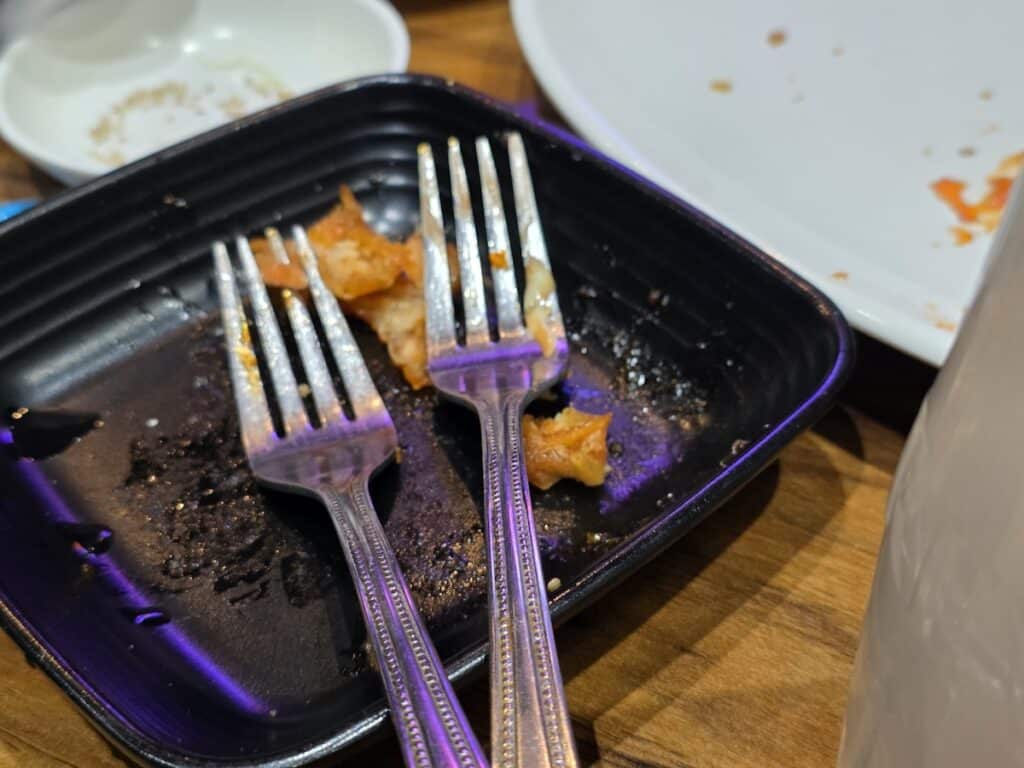
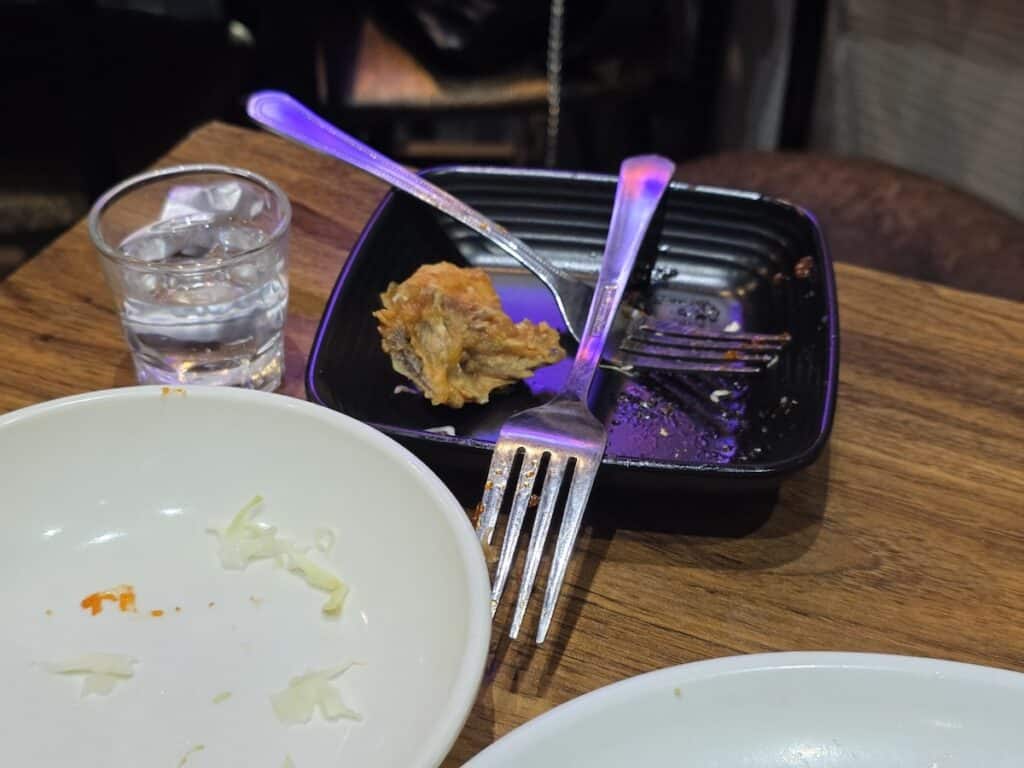
The true cinematic quality of The Dual Fork Ritual is found not in the pristine beginning, but in the messy, satisfying conclusion. The images (image_7.png, image_8.png, image_9.png) capture this beautiful, chaotic aftermath perfectly. A single, perfect piece of golden-fried chicken skin left on a black plate, flanked by the used, sauce-stained forks, is a still-life portrait of a ritual completed.
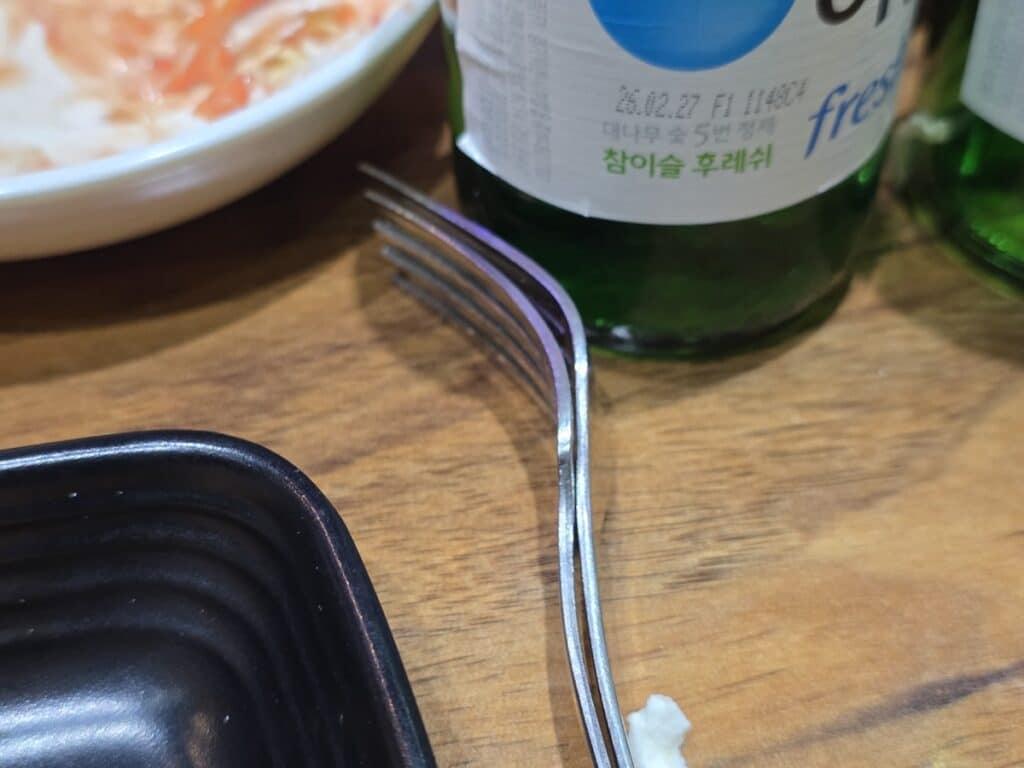
These images are the silent testimony of a diner who conquered the spice and the sauce without ever needing a wet wipe. They reveal the complex landscape of flavors and textures that were meticulously navigated. A final image of the stacked, used forks resting against a Soju bottle (image_11.png) shows the tools of a successful culinary surgical operation. It is the photographic proof of a diner who understood the ritual.
4. The One Bone Exception: Where Comfort Meets Taste
Of course, even in Korea, the ritual has its pragmatic limits. The host knows that certain parts of the chicken are not dual-fork friendly. When you reach the smallest, most flavorful bones, like the wing tip or a small drumette, the forks become too cumbersome. This is when the “Sensible Diner” is granted a ritual exception. You will see Koreans pick up these final pieces with their thumb and index finger for a quick, precise bite. It is the moment you acknowledge that some flavors are too good to be bound by tools. But for 90% of the meal, the forks are supreme.
5. Embracing the Fork: A Sensible Traveler’s Guide to K-Chicken
For the Western traveler, The Dual Fork Ritual is more than just a novelty; it is an initiation into the heart of modern Korean dining psychology. The next time you walk into a K-Chicken shop, don’t ask for wet wipes. Embrace the forks. Watch the locals. Master the anchor-and-pry technique. In doing so, you are not just eating food; you are participating in a sophisticated, cinematic ritual that shows you respect the culture and the care that went into every crispy, saucy bite.
6. Action Plan: Conquer the Dual Fork Challenge
- 6.1 Observation Ritual: Spend the first five minutes of your meal watching how the locals use their forks. Every region and every restaurant has a slightly different technique.
- 6.2 The “Two-Finger” Grab: Remember the One Bone Exception. If you must use your hands for a small piece, use only your thumb and index finger.
- 6.3 Share the Ritual: When dining with others, help them understand The Dual Fork Ritual. It is a great conversation starter and a fun cultural experience.
7. Related Guides: Master Your Seoul Gourmet Experience
- 10 Authentic Korean Dining Etiquette with Scissors: Beyond the Knife This guide explores the fascinating world of Korean table-side tool mastery, connecting the Dual Fork Ritual to our unique “Scissor Culture.”
- 7 Secrets of the Post-BBQ Meal Ritual in Korea: The Savory Dessert After conquering chicken, master the art of the perfect savory finish to a K-BBQ feast.
- 8 Vegan Banchan Secrets for a Stress-Free Korean Food Trip Not everything in Korea is fried chicken. This guide helps you navigate the complex world of plant-based side dishes.
8. Conclusion: The Local Soul in a Global Dish
While fried chicken is a global phenomenon loved from New York to Singapore, the way we embrace it in Korea is deeply rooted in our local dining soul. The Dual Fork Ritual is not an elite ceremony; it is a common, everyday courtesy that any Korean restaurant will naturally provide. If you ever find yourself at a table with only one fork, do not hesitate to ask for another. In any K-chicken shop, requesting an extra fork is a perfectly “Sensible” act that every host understands and expects.
This simple pair of metal tools transforms a worldwide favorite into a uniquely Korean experience. It represents our obsessive care for detail—the desire to enjoy the messiest, tastiest sauces while maintaining a ritual of cleanliness and respect. By mastering the forks, you are not just eating local food; you are adopting a local perspective. Next time you face a mountain of crispy K-chicken, remember: the true secret to the flavor is held between two forks, balancing the global love for chicken with the sophisticated heart of Korean hospitality.