In the world of Korean BBQ, the grilled meat is merely the opening act. The true climax—the moment every local is secretly waiting for—is when the server brings out a bowl of rice and a pair of spatulas. The Korean BBQ Fried Rice Ritual (Bokkeumbap) is not just a side dish; it is a sophisticated cultural and psychological maneuver designed to extract every last drop of flavor and value from the table.
The Alchemy of Residual Fat
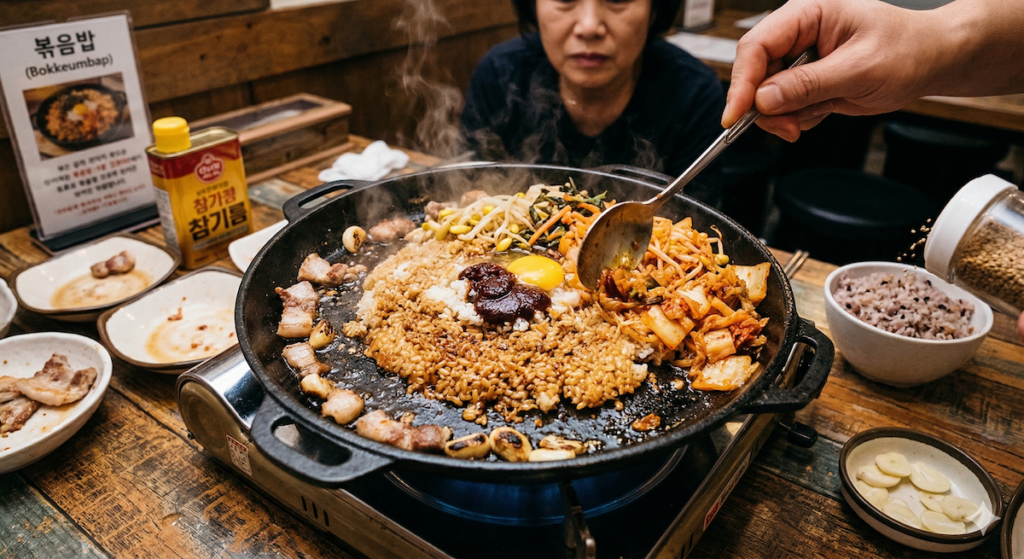
To the uninitiated, a greasy pan covered in charred bits of pork and kimchi juice might look like a mess to be cleaned. To a Korean, this is “Liquid Gold.” We do not discard the rendered fat from high-quality pork belly; we use it as a high-heat conductor to sear rice, creating a Maillard reaction that soy sauce alone could never achieve. In the Korean BBQ Fried Rice Ritual, the fat is the star, and the rice is merely the canvas.
Beyond the Snack: Elevating the Status of the Meal
There is a profound psychological shift that happens when the rice hits the pan. Whether you are eating Tteokbokki (traditionally a snack) or a casual meat dish, the act of frying rice elevates the experience to a “proper meal.” This transition satisfies a deep-seated cultural need for substantiality, ensuring that the dining experience feels complete, respected, and—most importantly—worth the price.
The History of Scarcity: Why We Crave White Rice
Until only a few decades ago, Korea was not the wealthy nation it is today. For the generation of our parents and grandparents, pure white rice was the ultimate symbol of prosperity and survival. During times of war and poverty, a bowl of white rice was a luxury that many could only dream of.
The “Grand Finale” Syndrome
This historical trauma created a unique dining habit: the “Rice Finale.” Whether you are eating a high-end raw fish platter or a spicy pork stir-fry, the meal is considered “unfinished” until rice is involved. This is why you will see Koreans tossing a bowl of rice into the leftover spicy sauce of a hot pot or a stew. We are subconsciously programmed to ensure that not a single drop of flavor is wasted, as it must be used to coat the “sacred” rice.
The Nutritional Reality: The Carbohydrate Trap
However, in 2026, this cultural obsession faces a harsh nutritional reality. Modern Koreans are no longer struggling with calorie scarcity; we are struggling with Carbohydrate Overload.
The Burden of Refined Carbs
The traditional practice of eating white rice after a full meal of protein results in a massive glucose spike. From a scientific perspective, the “Rice Finale” is often an unnecessary addition of refined sugars to an already complete meal. Our parents’ generation may still view a meal without rice as incomplete, but the younger, health-conscious generation is beginning to question this legacy.
The Rice Strategy: A Biological Defense Mechanism
Interestingly, the Korean BBQ Fried Rice Ritual provides a fascinating, if unintentional, solution to the nutritional dilemma of the “Carbohydrate Trap.” While the cultural craving for a rice finale is absolute, the way we construct this final dish has evolved into a strategic balance of nutrients.
The Fiber Buffer and Multi-grain Shift
The modern version of the Bokkeumbap (fried rice) is no longer just white rice and grease. In a conscious effort to manage the glycemic load, many Korean restaurants and households now incorporate a massive volume of chopped Kimchi, bean sprouts, and seasoned wild greens (Namul) directly into the frying pan. Furthermore, there is a significant shift toward using Japgok-bap (Multi-grain rice) or mixing in barley to provide a fiber buffer that slows down the absorption of sugars from the rice.
Turning Survival into Strategy
When you watch the server mix a small portion of rice with a large mountain of high-fiber vegetables in the residual pork fat, you are witnessing a transition from Survival Dining (filling up on pure calories) to Strategic Dining (balancing flavor, heritage, and metabolic health). The fried rice finale isn’t just a way to “get your money’s worth” (Bon-jeon); it’s about making a high-carb culture sustainable in a modern, sedentary world. It is the ultimate compromise between our historical love for rice and our contemporary need for health.
The “Fullness” Strategy: The Psychology of the Ultimate Refill
In the Korean dining ritual, a meal is often divided into two acts: the “Main Experience” and the “Substantial Conclusion.” This isn’t just a culinary habit; it is a psychological and economic strategy designed to ensure that no guest leaves the table with a lingering sense of hunger or a feeling of “lost value.”
The Alchemy of Fat and Grain: Why We Fry Rice
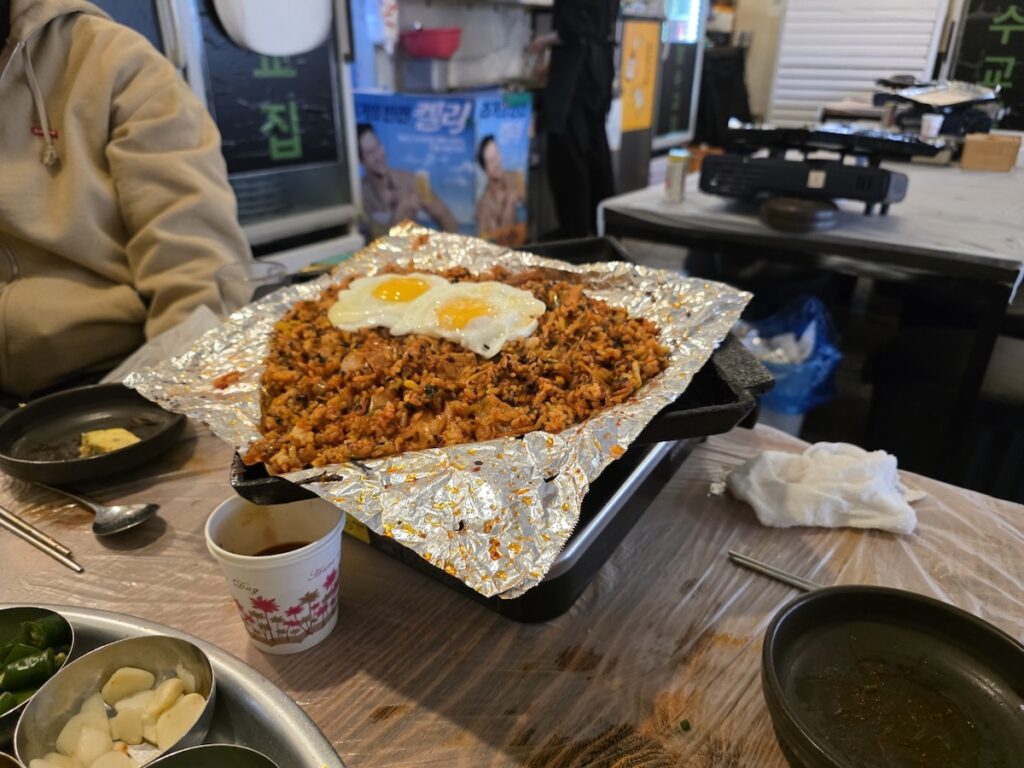
When you finish your grilled meat, the pan is coated with rendered animal fat—the essence of flavor and calories. From a historical perspective of scarcity, discarding this fat was unthinkable. By adding kimchi, vegetables, and rice to this oil, Koreans create a new dish that balances heavy animal fats with high-fiber greens. This “Second Act” transforms a simple protein meal into a multi-layered feast, ensuring you extract every last calorie and cent of value from the grill.
The Color and Texture Contrast: Boribap and Kalguksu
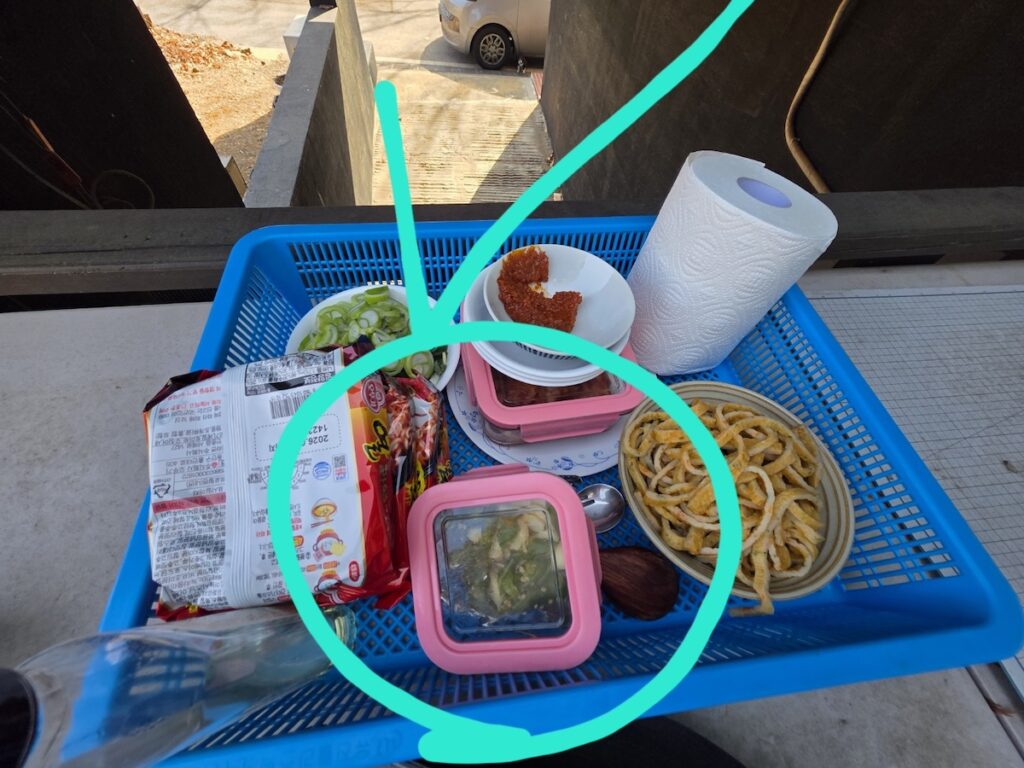
This strategy is also visible in the pairing of Kalguksu (Hand-cut noodles) and Boribap (Barley rice). The noodles are white, soft, and mild—a comforting but simple carbohydrate. By serving a small bowl of coarse, brownish barley rice with vibrant red Gochujang before or after, the restaurant provides a psychological “health buffer.” The barley feels rustic and nutritional, while the red-on-white visual contrast makes the meal feel diverse and expensive, even if the ingredients are humble.
From Snack to Meal: The Tteokbokki Transformation
The most extreme example is found in Jeukseok Tteokbokki (Table-side rice cakes). In Korea, Tteokbokki is often classified as “Bunsik” or a snack. However, the moment you stir-fry rice in the remaining spicy sauce, the “snack” is elevated to a “proper meal.” This transition is a direct response to the fear of deficiency; it is a marketing masterstroke that convinces the consumer they have upgraded their dining experience from a quick bite to a full-course sit-down dinner.
The “Value for Money” Ritual: Harvesting the Essence
At its core, this obsession with the rice finale is about “Bon-jeon” (Breaking even). It is a cultural drive to “get one’s money’s worth.” By ensuring the meal ends with a heavy, satisfying carbohydrate, restaurants eliminate the risk of a customer feeling unsatisfied. It is where the historical fear of hunger meets the modern marketing of “infinite value,” making the Korean table a place where the concept of “enough” is always defined by the presence of rice.
Action Plan: Don’t Over-order—The “Second Act” is Coming
For the uninitiated traveler, the Korean dining experience can feel like a deceptive marathon. You might think you’ve finished your meal after the main course of grilled meat or spicy stew, but in Korea, the table is designed for a “Second Act.” Whether it’s stir-fried rice, cold noodles, or a hearty soup, there is almost always a hidden sequel to your meal. Here is how to navigate this like a local without overextending your stomach.
Expect the Transformation
In most Korean communal dining—whether it’s Jeukseok Tteokbokki (table-side rice cakes), Dakgalbi (spicy chicken), or even Hwe (raw fish)—the pot on your table is not static. It is a vessel meant to evolve.
- The Rule of Thumb: If there is a sauce, a broth, or a greasy pan left after your main protein is gone, there is a high probability of a “Bokkeumbap” (fried rice) or “Sari” (extra noodles) option. ### The Strategy: Order “N-1” The most common mistake for foreigners is ordering one portion per person right at the beginning. If there are four of you, don’t immediately order four portions of meat.
- The Pro Tip: Order one portion less than the number of people in your group (e.g., three portions for four people). This “empty space” in your stomach is a strategic reserve for the Grand Finale.
Embrace the “Bokkeumbap” Ritual
When the waiter asks, “Bokkeumbap deusi-get-seoyo?” (Would you like fried rice?), they are offering you the most flavorful part of the evening. By saving room, you can enjoy the essence of the meal—the concentrated fats and spices—absorbed into a thin, crispy layer of rice.
Know Your Limits: Health over “Bon-jeon”
While the cultural drive for “getting your money’s worth” (Bon-jeon) is strong, remember our previous discussion on the Carbohydrate Trap. You don’t have to finish every grain. Enjoy the ritual, taste the transition from “snack” to “meal,” but be mindful of your metabolic balance. The goal is to experience the Korean Dining Ritual in its entirety, not to leave the table in physical discomfort.
Related Insights: Deepen Your Understanding of Korean Food Science
While we maximize meat fat for the Korean BBQ Fried Rice Ritual, the world of raw fish follows a different logic of layering. Discover why wrapping pristine seafood in perilla leaves is not “masking” flavor, but a sophisticated biological optimization of texture and safety.
The precision required to fry the perfect Bokkeumbap is mirrored in the delicate deboning of grilled belt fish. Explore the “surgery-like” technique of the Korean table and how extracting every ounce of white flesh satisfies the same Bon-jeon (value) drive as our crispy rice finale.
After a heavy, fat-saturated Korean BBQ Fried Rice Ritual, the ritual often continues at the 24-hour convenience store. Learn the science behind the “Anti-hangover” drinks and light snacks that Seoulites use to balance their metabolic system before the night ends.
Conclusion: The Final Scrape—The Alchemy of Fat and Survival
The Korean BBQ Fried Rice Ritual is the ultimate testament to a culture that refuses to let flavor—or value—go to waste. When you watch the server scrape the charred bits of pork fat and kimchi into a mound of rice, you aren’t just watching a cooking technique; you are witnessing the psychological climax of the Korean table. This is the ritual of “Bon-jeon” (Breaking even), a deeply ingrained drive to extract every last drop of essence from the meal you’ve paid for.
In this final act, the hierarchy of the meal shifts. The expensive meat was merely the precursor, the source of the “Liquid Gold” (pig fat) that now coats every grain of rice. This transformation is what elevates a simple protein session or a casual snack like Tteokbokki into a “Proper Meal.” It provides the emotional and physical security that only a heavy, fat-saturated carbohydrate can offer—a lingering echo of a history where a full stomach was the greatest luxury.
So, when you are offered the Bokkeumbap finale, do not see it as an optional side dish. See it as the most sophisticated moment of the evening. Use the “N-1 Strategy” to ensure you have the metabolic space to participate. In that crispy, golden layer of rice stuck to the bottom of the pan, you will find the true soul of modern Korean dining—a masterful blend of historical survival, economic grit, and the relentless pursuit of the perfect, fatty bite.