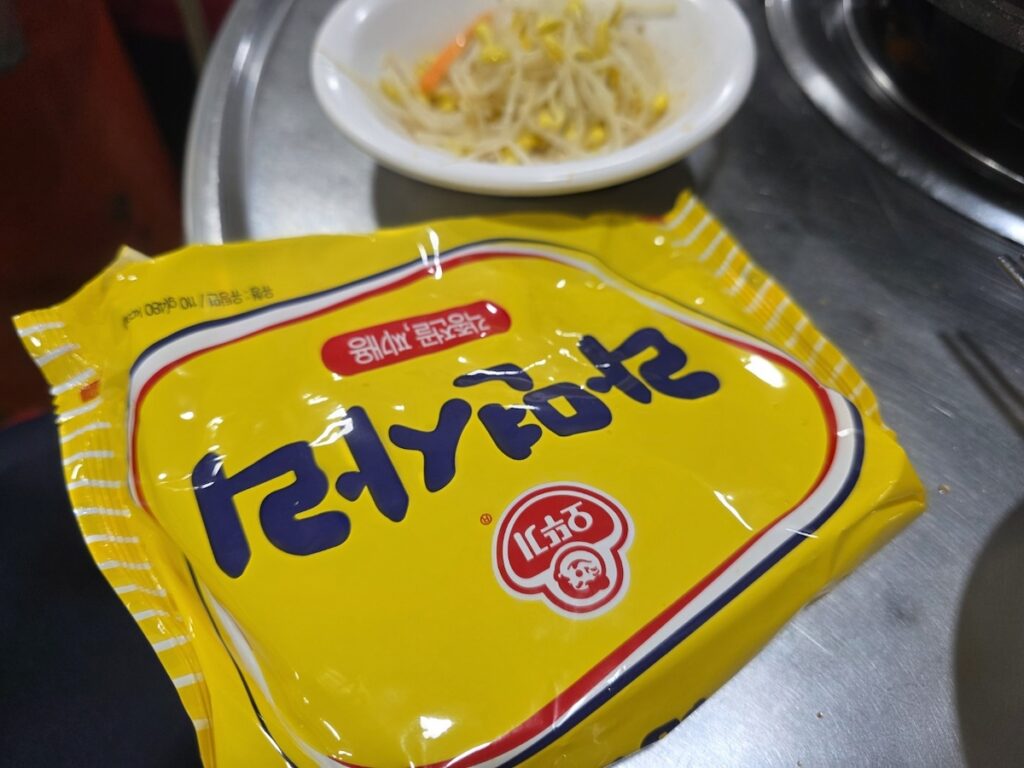
Ramyeon Sari Ritual is the silent, non-negotiable climax of the Korean dining experience. Even today, as I sat before a bubbling pot of Kimchi-jjigae for lunch, I found myself reaching for the menu to order a ‘Sari’ for an extra 1,000 won without a second thought. I didn’t even ask for my colleagues’ consent. In the hierarchy of a Korean meal, certain decisions transcend democratic agreement; they are essential. Adding that deep-fried block of noodles isn’t an option—it is a fundamental requirement to complete the broth’s destiny.
The Cultural Code: Ramyeon as a Sophisticated Deviation
To understand the Ramyeon Sari Ritual, one must recognize it as a “Small Rebellion.” While we are acutely aware of the nutritional debate surrounding instant noodles, the act of dropping them into a shared stew represents a calculated departure from our daily discipline. It is a moment where the table collectively agrees (or implicitly accepts) that flavor and the joy of the present moment take precedence over caloric scrutiny. It is a sophisticated deviation that transforms a humble stew into a shared cinematic event.
The Science of Viscosity: How Starch Transforms the Broth
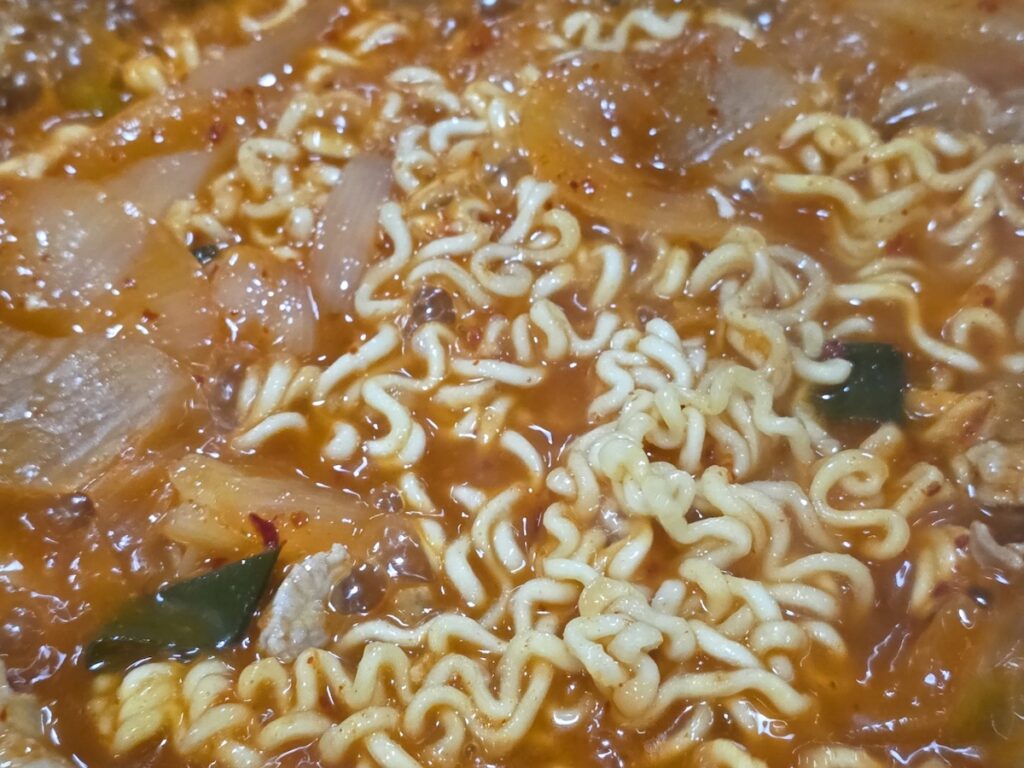
The magic of the Ramyeon Sari lies in its chemical interaction with the existing stew. As the noodles boil, they undergo a process called Gelatinization.
1. The Guardian of Health: A Korean mother views her Kimchi-jjigae as a nutritional fortress. To her, adding processed noodles is a “contamination” of the slow-cooked nutrients she has prepared for her family. At home, we eat to survive and thrive; at the restaurant, we eat to indulge.
2. The Culinary Architecture: Most homes utilize a fixed gas range where the cooking stops once the pot hits the table. Without the constant blue flame of a Portable Gas Burner (Gas-burner) found in restaurants, the noodles cannot maintain the high temperature required for perfect elasticity. We have subconsciously inherited this boundary, saving our “Sari cravings” for the live-fire environment of a professional eatery.
The Science of Viscosity: How Starch Transforms the Broth
The magic of the Ramyeon Sari Ritual lies in the hidden chemistry of Gelatinization.
- Viscosity Shift: As the noodles boil, they release starch into the liquid. This increases the broth’s thickness, turning a watery soup into a rich, velvety sauce that clings to every ingredient.
- The Absorption Paradox: The noodles act like a “Hollow Cylinder,” suctioning the concentrated essence of the spices and fats into their core. This is why the last bite of a noodle often tastes more intense than the first bite of the stew.
The Master’s Timing: The Thermodynamics of Starch Integration
The timing of the Ramyeon Sari Ritual is a precise calculation of heat transfer and molecular absorption. To achieve the perfect “Al Dente” texture while ensuring the broth reaches its peak viscosity, one must understand the interaction between the liquid’s boiling point and the noodle’s structural integrity.
1. The Critical Temperature Zone (85°C – 100°C)
The wheat starch in Ramyeon begins its Gelatinization at approximately 60°C, but the optimal “Sari Integration” occurs only when the broth is at a rolling boil (95°C+). At this temperature, the water molecules penetrate the noodle’s protein matrix at an accelerated rate. If added when the stove is off (as often happens at home), the noodle merely “soaks,” leading to a flaccid, mushy texture known as “degraded elasticity.”
2. The Osmotic Pressure Paradox
The concentration of salts and sugars in the stew creates Osmotic Pressure. If the Sari is added too early (at the start of the meal), the broth is too thin, and the noodle absorbs only water, leaving the flavor on the surface. If added too late, the broth is too concentrated (high salinity), which can actually inhibit the noodle’s ability to soften evenly, resulting in an “undercooked core” despite a soggy exterior.
3. Precision Timing Matrix by Culinary Fluidity
Below is the scientific data for the optimal “Sari Window” based on broth density and ingredient composition.
The “Yuksu” Strategy: Managing the Liquid Gold
A professional diner at a Korean restaurant knows the power of the word “Yuksu” (육수). Because the Ramyeon Sari is so thirsty, the pot will eventually run dry.
- The Request: Never hesitate to ask the server for “Yuksu-jom-deo-juseyo” (More broth, please).
- The Temperature Control: Adding cold broth can stop the cooking process. High-end establishments often provide boiling-hot broth to maintain the noodle’s elasticity (Al Dente).
- The Pre-Boil Ritual: In some sophisticated settings, the noodles are parboiled in a separate pot to remove excess oil and salt before being added to the main stew. This keeps the broth clear while still providing that essential carbohydrate finish.
🏮 Related Guides for Your Culinary Journey
Expand your understanding of the Korean table by exploring these specialized rituals. Each guide provides a deeper dive into the science, philosophy, and cultural resilience of our gastronomy.
- Korean Food Rituals 2026: The Philosophy of Sundays, Soup, and the Meat Debate While the Ramyeon Sari Ritual focuses on the indulgence of the week, our exploration of Sunday soups delves into the restorative nature of slow-cooked broths. Understand how the debate between meat-heavy and vegetable-forward stocks shapes the modern Korean family dynamic.
- The Science of Texture 2026: Why “Sticky” Fails to Define the Korean Palate The starch gelatinization you witnessed in your Ramyeon is just the beginning. This guide deconstructs the complex linguistic and sensory world of Korean textures, explaining why the western term “sticky” cannot capture the nuanced elasticity of a perfectly timed noodle.
- Korea Street Food Guide 2026: The Secret Ritual of Friday Night Comfort If the Sari is a midday rebellion, the Friday night street food scene is a full-scale liberation. Learn the secret codes of Pojangmacha (tent bars) and why the atmospheric “Live Fire” is essential for the ultimate weekend comfort ritual.
- Vegan Tteokbokki Ritual 2026: The Inclusive Soul of Korean Gastronomy Discover how the core principles of the Ramyeon Sari Ritual—viscosity, starch, and spice—are being reimagined for the global vegan community. This guide proves that the soul of Korean gastronomy is inclusive, resilient, and scientifically adaptable to all dietary needs.
The Psychology of the Motherly Hearth: Why We Don’t Add Sari at Home
The Ramyeon Sari Ritual is almost exclusively an outdoor phenomenon, and the reasons are as much psychological as they are logistical. At the center of the Korean home is the Mother—the silent guardian of the family’s vitality. In a Korean household, Kimchi-jjigae is not just a meal; it is a nutritional sanctuary built on aged ferments and carefully selected proteins.
1. The Mother’s Unwritten Rule: Health over Indulgence
For a Korean mother, adding a deep-fried, processed noodle to a painstakingly simmered stew is often seen as a “contamination” of health. Her culinary philosophy is rooted in the Motherly Instinct to protect her children from the preservatives and high sodium levels associated with instant noodles. While she might cook a pot of Ramyeon as a quick snack, she rarely allows it to breach the sanctity of her slow-cooked Jjigae. This psychological barrier creates a clear distinction: home is for nourishment, while the restaurant is for the “rebellion.”
2. The Logistical Barrier: The Fixed Stove vs. The Portable Burner
Beyond psychology, there is a fundamental difference in the Culinary Architecture.
- The Home Kitchen: At home, stews are typically cooked on a fixed gas range (Gas-range). Once the pot is brought to the dining table, the cooking process stops. The broth begins to cool, making it physically impossible to cook a Ramyeon Sari to that perfect “Al Dente” texture without returning to the kitchen—a move that breaks the flow of the family meal.
- The Restaurant Table: Conversely, Korean restaurants utilize the Portable Gas Burner (Gas-burner). This constant flame allows for a continuous, evolving cooking process. The Ramyeon Sari requires this “Live Fire” to maintain the high temperature necessary for starch gelatinization at the table. Without the steady blue flame in front of us, the ritual simply cannot exist.
3. The Inherited Habit
As we grow, we subconsciously inherit this motherly boundary. We learn that a stew at home is a finished masterpiece, meant to be enjoyed with a bowl of pure white rice. We save our cravings for the “Sari” for the bustling atmosphere of a local eatery, where the presence of the portable burner signals that the rules of the home no longer apply. It is this tension between Homebound Discipline and Social Indulgence that makes the Ramyeon Sari taste so much better when we are away from our mother’s kitchen.
Action Plan: How to Order Like a Local
If you find yourself in a bustling Seoul eatery, follow this sequence to master the Ramyeon Sari ritual:
- The Observation: Wait until the main protein (chicken, pork, or fish) has fully flavored the broth.
- The Addition: Order one Ramyeon Sari. If the broth is already low, order a “Yuksu” refill at the same time.
- The Boil: Do not overcook. Aim for a slightly firm texture, as the noodles will continue to cook in the residual heat of the stone pot.
- The Pairing: Pair this “guilty” moment with a refreshing side of cold radish kimchi to balance the starch with acidity.
Conclusion: Embracing the Imperfect Harmony
The Ramyeon Sari is a reminder that food is not just fuel; it is a narrative. It is the story of a culture that finds joy in the balance between health and indulgence. By understanding the science of starch and the ritual of timing, you turn a simple bowl of noodles into a cinematic experience of Korean hospitality. The next time you see a pot bubbling over a blue flame, don’t just see a meal—see an opportunity for a delicious, sophisticated rebellion.