Korean Dining Etiquette with Scissors often begins at the moment of silent hesitation. You sit in a rustic Gukbab house or a lively neighborhood restaurant, and you are faced with a giant, uncut stalk of Kimchi or a massive radish. It looks intimidating, it looks spicy, and most importantly, it feels impossible to eat gracefully.
In a dining environment where no western steak knife is provided, you might feel a sudden sense of discomfort—a fear of being messy or lacking the manners to portion your food properly.
You wonder how to navigate these oversized ingredients without a knife and fork. This is where the kitchen shear becomes your most sophisticated ally. It is the Korean answer to dining with poise, allowing you to transform a daunting bowl of fermented greens into a refined, manageable feast. It is not just a tool; it is the ultimate graceful solution to the “knife-less” table.
01. The Etiquette of the “Snip”: Taming Intimidating Kimchi
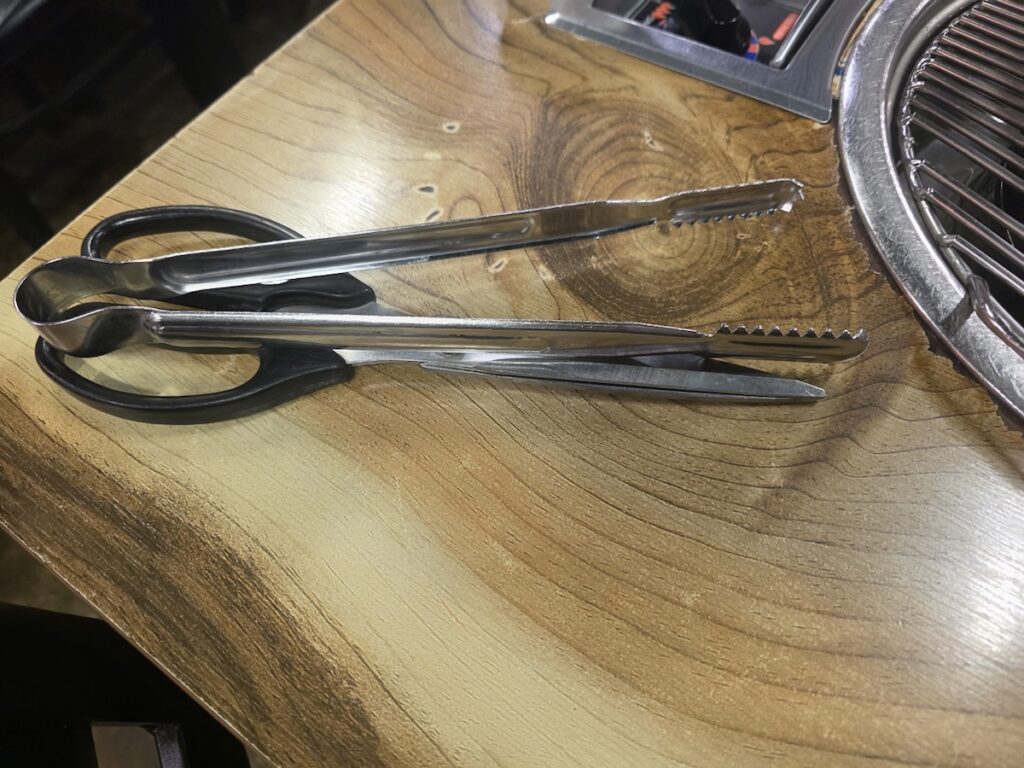
In many traditional restaurants, Kimchi is served in long, uncut stalks to prove its freshness and quality. Attempting to tear these with chopsticks often leads to red splashes and awkward moments. The first rule of Korean Dining Etiquette with Scissors is to portion the Kimchi into 3cm segments. This allows you to eat gracefully without the fear of staining your clothes or struggling with oversized leaves.
02. The Kkakdugi Quartering: Safety in a Gukbab House
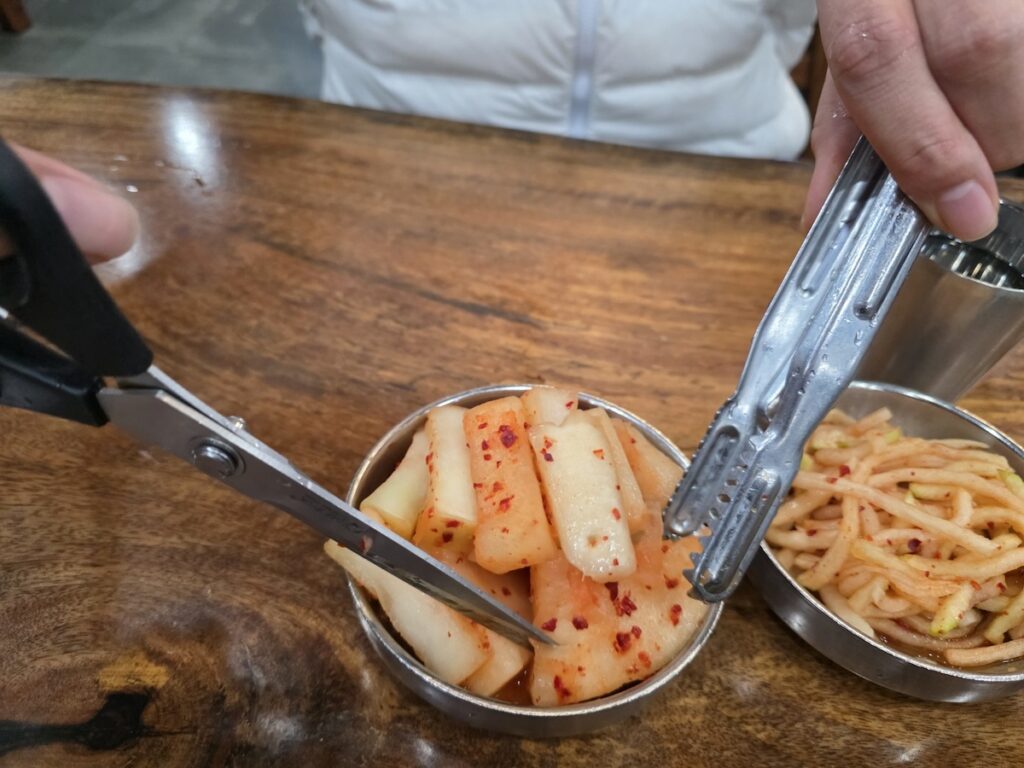
Large radish cubes (Kkakdugi) are the soul of a good soup house, but they are notoriously crunchy and slippery. To avoid an embarrassing splash in your boiling broth, use the tongs to lift the cube and snip it into four clean quarters. This small act is a hallmark of a seasoned diner who understands the rhythm of the table.
03. The Mother’s Kitchen Legacy: Why I Gifted an Oh-Bok
One year ago, I made a “Midnight Run” to a traditional hardware stall to find the perfect pair of genuine Oh-Bok scissors for my mother. In the West, gifting scissors might carry a sharp superstition, but in the Korean hearth, it is a profound gesture of care. I remember watching her skeptical face turn into one of pure culinary liberation the moment she snipped through a thick, fibrous radish without a single drop of splash.
These aren’t just “scissors”; they are a piece of specialized Korean engineering that I personally vetted to replace her heavy, cumbersome knives. When you take a pair home, you aren’t just buying a tool—you are exporting the very soul of Korean efficiency that I trust for my own family.
04. Trimming the Naengmyeon: The Cross-Cut Safety Ritual
The long, elastic buckwheat noodles of Naengmyeon are symbols of longevity, but they can be difficult to manage. The server will often offer a “cross-cut” (two snips in an X shape). Accepting this is part of the modern ritual, ensuring the noodles are manageable and the dining experience remains fluid.
05. The Pancake Partition: Respecting the Texture of Jeon
Communal vegetable pancakes (Jeon) are meant to be shared. Instead of pulling them apart messily with chopsticks, using scissors ensures clean edges and preserves the crispy texture for everyone at the table. It is an act of consideration for your dining companions.
06. The Global “Aha!” Moment: Beyond the Western Plate
The fascination with the Korean Dining Etiquette with Scissors isn’t just a local obsession; it’s a revelation for culinary giants. I recall the late Anthony Bourdain’s sheer delight at the rhythmic “clinking” of metal shears in a Seoul market—he saw it not as a shortcut, but as a form of “tabletop theater” that prioritized the diner’s comfort over outdated European etiquette.
Even David Chang has championed this “3D Cutting” technique, arguing that lifting a piece of Kimchi and snipping it mid-air preserves the texture far better than a flat cutting board ever could. For those who feel trapped by the lack of a knife, this is the moment you realize that the most sophisticated way to eat isn’t with a blade, but with a snip that resonates with centuries of practical wisdom.
07. Trimming for Customization: The Diner’s Choice
Scissors provide a level of customization that a pre-cut dish cannot. Whether you are snipping away a charred edge or separating a specific garnish, the tool allows each diner to tailor their meal to their personal dietary needs in real-time.
08. The Herb and Garnish Snip: Capturing Aromatics
In many stews, fresh leeks or spicy peppers are added as a final touch. A skilled server or host will snip these directly into the boiling pot. This ensures that the volatile oils and fresh aromas are released instantly into the broth right before you take your first sip.
09. Chopstick Assistance for Beginners
For those still perfecting their chopstick skills, the scissor is a silent ally. Trimming slippery mushrooms or heavy greens into smaller, lighter pieces makes them easier to grip, preventing spills and splashes in communal pots.
10. The Ultimate Export: A Gift of Practicality
When you leave Korea, skip the generic souvenirs. A pair of professional-grade Korean food scissors is the ultimate gift. It outlasts any gadget and serves as a daily reminder of the efficiency and hospitality you experienced at the Korean table.
Premium Food Scissor Selection for Your Gift List
| Brand Name | Specialization | Why It’s a Great Gift |
| Oh-Bok (오복) | The Industry Standard | Unmatched durability; used in the best BBQ houses. |
| Dorco (도루코) | Precision Razor Steel | Famous for the sharpest blades and ergonomic grips. |
| Henckels (KR Ed.) | Luxury Fusion | A mix of German engineering and Korean function. |
Real Experience: The Click of the Hearth
I remember a crowded Gukbab house during a winter storm. The steam fogged the windows, and the sound of the restaurant was a symphony of spoons hitting porcelain and the constant click-clack of shears. I watched a businessman carefully snip his Kimchi, then pass the scissors to his junior. It wasn’t just about eating; it was a rhythmic, shared ritual. That metallic sound is the true “white noise” of Korean comfort.
Related Guides
- 8 Vegan Banchan Secrets for a Stress-Free Korean Food Trip: Navigate the side-dish spread like a pro.
- 5 Umami Secrets of Ganjang-gejang: The Ultimate Soy-Marinated Crab Ritual: A guide to mastering Korea’s complex seafood.
- 7 Vegan Nurungji Breakfast Rituals: The Ultimate Korean Gluten-Free Morning: The healing power of scorched rice.
Conclusion: The Ultimate Gift of Practical Wisdom
As you prepare to leave Korea, you might find yourself looking at the stainless steel shears on the restaurant table one last time. In your home country, using scissors at a dinner party might raise a few eyebrows or seem “strange” to those unaccustomed to the ritual. But as we often say in Korea, every tradition has its reason. Just as we might find certain Western dining tools curious, the Korean Dining Etiquette with Scissors is born from a desire for efficiency, cleanliness, and communal care.
The “Snip” you hear in a busy Gukbab house is the sound of a culture that values your comfort over rigid, outdated formalities. It is a solution for the guest who wants to eat with dignity when no knife is in sight. This is why a pair of professional-grade food scissors is the ultimate souvenir. When you gift them to a loved one back home, you aren’t just giving them a kitchen tool; you are sharing a piece of Korean life that says, “I want your life to be easier.” It is a gift of “Korean Kitchen Soul”—a practical, sharp, and enduring reminder that sometimes, the most sophisticated way to move forward is to simply snip away the inconvenience.
Action Plan
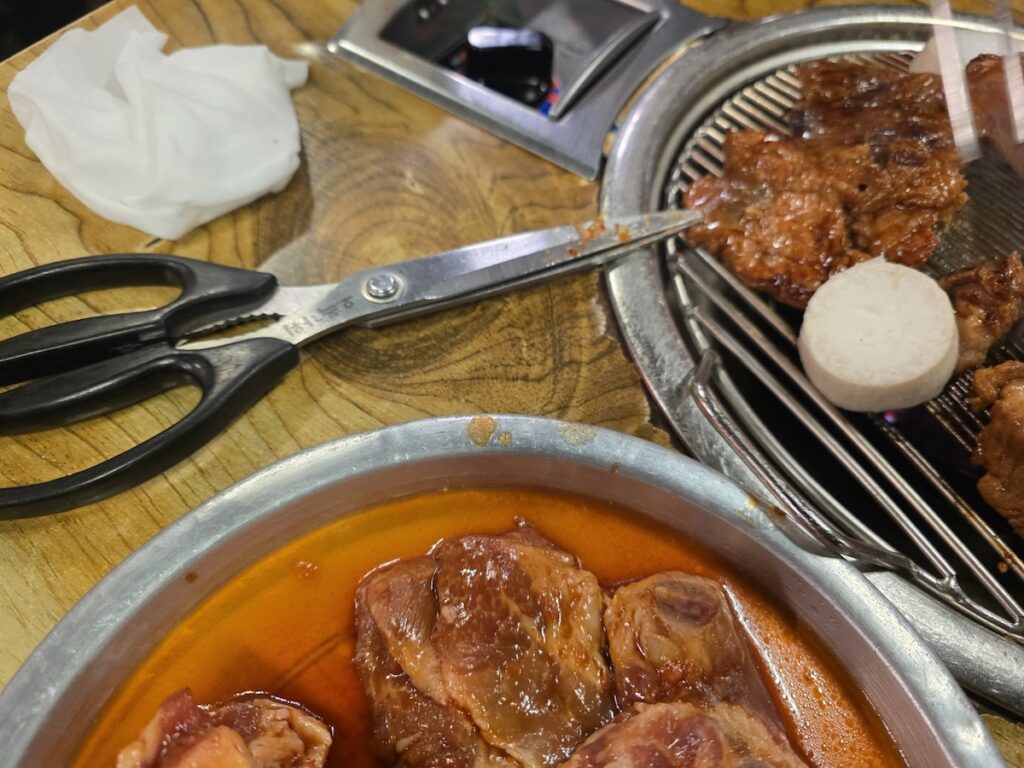
- Spot the Logo: Look for the engraving on the blade at your next meal to see the quality.
- Ask Confidently: Don’t struggle with large pieces. Simply say “Gawi juseyo” (Scissors, please).
- The Gift Hunt: Visit a local traditional market to find professional-grade shears to take home.
- Practice the Ritual: Use the scissors to prepare food for your companions as a sign of Korean hospitality.